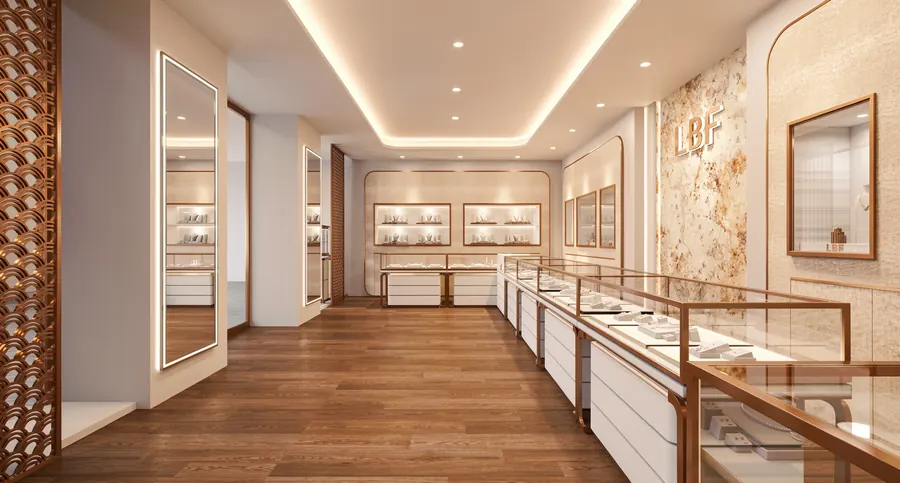
A jewelry kiosk rarely fails in a mall because the jewelry is wrong. It fails because the display case is 40 mm too tall for the sightline rule, the glass is not laminated as the property manager requires, or the low-voltage lighting has no test certificate on file. Mall approvals are a specification exercise, and the display case sits at the center of it. Before you approve a drawing or pay a deposit on jewelry kiosk display cases, walk through the points below with your fixture supplier. Most of them cost nothing to check and can save four to eight weeks of rework.
Start with the mall’s design criteria, not the catalog
Every shopping center has a tenant design criteria manual, usually 30 to 80 pages, covering kiosk footprint, height limits, setbacks, materials, colors and signage. Ask your leasing contact for the current version in writing and confirm which revision applies to your unit. Common requirements include a maximum overall height of 1,200 to 1,500 mm for common-area kiosks, a minimum 1,000 mm clear aisle around the unit, and casework finishes from an approved palette. A display case that meets a beautiful concept board but exceeds the height limit will be rejected at drawing review. Translate the manual into a one-page checklist and give it to your manufacturer before the first render.
Confirm footprint, weight and power before fabrication
Malls care about three physical facts: how much floor you occupy, how much load you place on it, and where the electricity comes from. A typical jewelry kiosk of 3 by 2 meters with six glass display cases and a back counter can weigh 800 to 1,500 kg when fully loaded with fixtures, stock and a safe. Property managers may require load spread over a stated area per square meter, especially on upper levels or over basement structures. Confirm the following with the mall’s engineering team and pass the answers to your supplier:
- Approved kiosk dimensions and required setbacks from columns, escalators and fire exits.
- Maximum permitted floor loading in kg per square meter, and whether a structural review is needed.
- Power supply location, available amperage, and whether 220V single phase or another configuration is standard.
- Rules on trailing cables, floor trunking or raised plinths, plus any requirement for an RCBO or isolation switch.
- Fire rating and finish class for casework, and whether glass must be tempered or laminated.
Getting the power figure right matters more than it sounds. LED strip lighting inside a display case typically draws 8 to 15 W per meter, and a kiosk with 20 meters of lighting plus a monitor and a small safe can sit comfortably under 1 kW, but the circuit layout and number of outlets still need written approval.
Lock down glass, locking and security specifications
Jewelry displays carry high-value stock, so mall security teams often have opinions. Expect questions about glass thickness, locking systems and how cases are anchored. For most kiosk work, 6 mm to 8 mm tempered glass is standard for sliding or lift-off tops, while laminated glass may be specified where breakage behavior matters. Ask whether the mall requires a specific lock type, key control policy or a safe bolted to the structure. If your cases use lift-off hoods, confirm that staff can secure them during restocking without leaving the kiosk unattended. Document the security specification in the drawing package; verbal agreements at a site meeting are difficult to enforce later.
Prepare the document package the mall will actually review
Approval delays usually come from missing paperwork rather than bad design. A complete submission typically includes scaled floor plans, elevations, a reflected ceiling or lighting plan, material and finish samples, a signage drawing, an electrical single-line diagram, and product certificates for lighting and electrical components. Some malls also request a fire test report for decorative materials and an insurance certificate. Assemble this as one indexed PDF in the order listed in the tenant manual. When the package is complete, first-round approvals commonly take 10 to 20 business days; incomplete submissions can restart the clock each time.
Agree fabrication and delivery milestones around the approval date
Do not release a production order until written approval is in hand. Custom jewelry kiosk display cases usually need four to six weeks for fabrication plus three to five weeks of sea freight to most export markets, with air freight as an option for tight openings. Build the schedule backward from your lease start date and add a buffer for customs clearance and on-site installation, which for a kiosk of this size is typically one to three days including electrical connection and leveling. Ask your supplier for a drawings-first workflow so dimensions can be checked against the approved plan before cutting begins.
At Libafang, kiosk projects are quoted and drawn against the tenant criteria you provide, with material and glass specifications listed line by line in the proposal so they can be matched against the mall’s manual. Keeping the approval checklist, the drawing set and the production schedule in one conversation is the simplest way to avoid a rejected submission.
Planning a kiosk opening? Send us your mall’s design criteria and footprint, and request a free design and quote for your jewelry kiosk display cases — we will return a layout, specification sheet and lead time you can submit for review.