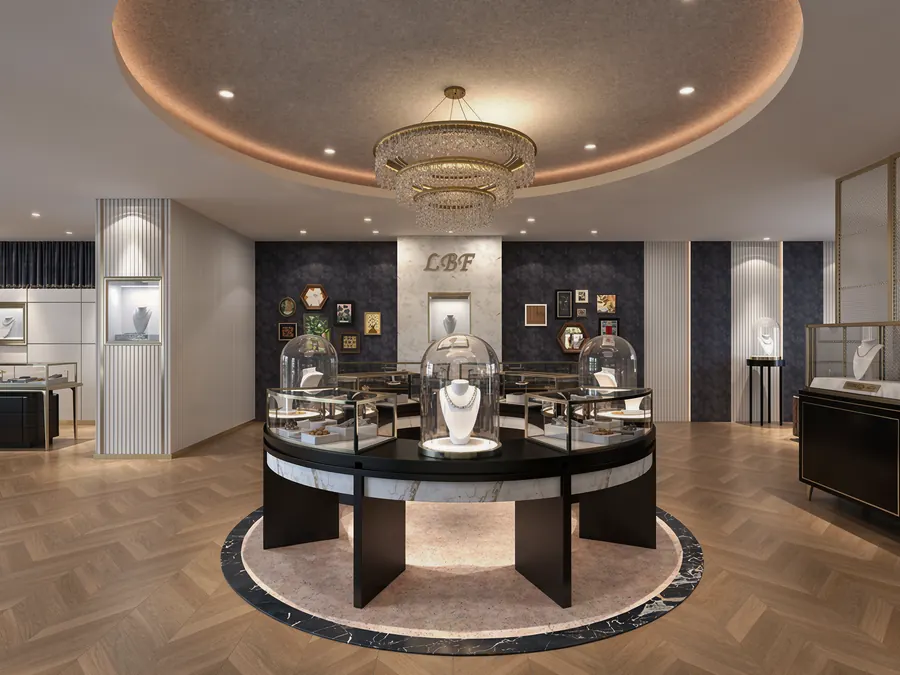
In jewelry retail, small does not mean limited. A 30–60㎡ store can outsell a 120㎡ showroom if every square meter is working hard. The key is to treat small jewelry store design as a precision exercise: each fixture, light, and pathway must justify its footprint. Whether you are fitting out a narrow street-front shop or a compact mall unit, the goal is to create an experience that feels intentional, not cramped. Here are field-tested ideas that balance visual impact, security, and operational flow.
Start With a Hard Layout: Zones Before Fixtures
Before choosing a single showcase, map the store into zones. A typical 40㎡ unit should allocate roughly 50% to display, 20% to customer circulation, 15% to checkout and consultation, and 15% to back-of-house or storage. For a 60㎡ space, the display area can stretch to 55%, giving you room for a small VIP nook. Keep the entry threshold clear: leave at least 1.2m of open floor inside the door so approaching customers do not feel trapped. If your store is deeper than 8m, place a hero showcase or a mirror at the rear to pull people in.
Zoning beats decoration. Draw the flow on paper at scale 1:50. Mark the main walking path from entrance to counter. In a linear 30㎡ shop, a single U-shaped path around a central island often works better than two parallel aisles. In wider 50–60㎡ units, a central island with perimeter wall cases creates a natural loop. Leave 90–120cm between fixtures so two people can pass comfortably, and never block sightlines from the entrance to the back wall.
Choose Fixtures That Do More Than One Job
In small stores, every unit should serve at least two functions. A glass-top counter can be a checkout point, a display for bestsellers, and a writing surface for consultations. A wall-mounted vertical case adds height without eating floor space. For a 30㎡ store, limit freestanding fixtures to three: one central island and two side counters. For 60㎡, you can add a slim tower case and a small seating bench that doubles as storage.
Concrete numbers help: a standard 1.2m x 0.6m glass showcase holds about 40–60 rings or 20–30 necklace busts, depending on tray layout. If you sell watches, a 1.5m wall case with 6–8 shelves displays 24–40 pieces. Choose modular fixtures on casters so you can reconfigure for seasonal events without new capital. For high-value items, specify laminated safety glass and lockable sliding doors as standard. That said, do not overfill. Leave 30–40% of each tray empty to make pieces feel curated and let light travel.
Lighting and Color: The Cheapest Way to Look Expensive
Bad lighting flattens diamonds and makes gold look dull. In a 40㎡ store, aim for a layered lighting plan: ambient ceiling light at 3000–3500K for overall warmth, plus focused LED spotlights at 4000–5000K with a CRI above 90 on each showcase. Use adjustable beam angles (15–24 degrees) to hit trays directly and create sparkle. For every 1㎡ of display surface, 800–1200 lumens of accent light is a reasonable starting range. Dimmers are not a luxury; they let you shift from bright day selling to evening events.
Wall color should recede, not compete. Deep navy, charcoal, or warm greige makes yellow gold and diamonds pop. Avoid pure white walls under warm light, which can cast a yellow tinge. Mirrors can double perceived space, but place them where they reflect showcases, not customers’ backs. A mirror behind the counter, angled slightly, can make a 30㎡ store feel 10–15% larger without changing the lease.
Security Without Turning the Store Into a Vault
Small stores are often targeted because they have fewer staff. Integrate security early. Use laminated glass (at least 6.38mm PVB) on all showcases. Install a discreet camera above the entrance and one behind the counter; 4K resolution covers a 40㎡ sales floor adequately. Keep the safe out of customer sight, ideally in a locked drawer under the checkout with a time-delay function. For after-hours, a roll-down grille or scissor gate should be specified in the lease fit-out plan.
Do not rely on a single staff member to watch everything. Design the layout so the counter has a clear view of the door and at least 80% of display surfaces. If you have a 60㎡ store, a second staff position near the rear case reduces blind spots. A simple rule: any customer should be within 4–5m of a staff member at all times during business hours.
Practical Ideas That Fit Small Footprints
- Vertical merchandising: Use tall wall cases up to 2.2m, but keep the top 30cm for brand signage or seasonal displays, not daily sales stock.
- Convertible consultation: A 1.8m counter with two stools can host private viewings; add a curtain track for quick visual privacy.
- Digital catalog: A 10-inch tablet on the counter shows inventory not on display; it saves 2–3㎡ of storage space.
- Narrow-depth cases: 40cm deep wall cases hold trays and take less floor space than 60cm versions, gaining you up to 1m of circulation width.
- Storage below: Every counter should have lockable drawers; a 1.2m counter can hide 4–6 trays of backup stock.
- Front window strategy: Keep the window display to 2–3 hero pieces; too many objects block the view inside and reduce walk-ins.
For a 30–60㎡ store, the most common mistake is buying fixtures before finalizing the layout. Order after you have a signed floor plan and lighting plan. Also consider lead times: custom showcases from a factory typically take 25–35 days for production plus shipping, so factor that into your opening schedule. Libafang builds custom display cases for jewelry and watch stores in over 30 countries, with modular options that suit small footprints and tight timelines.
Make Every Square Meter Earn
Small jewelry store design is not about cramming more in. It is about removing what does not sell and elevating what does. Start with zoning, add multi-functional fixtures, light each case properly, and keep security invisible but robust. A 40㎡ store with a clear path, three well-lit showcases, and a comfortable consultation spot can feel as premium as a space twice its size. Measure your layout in centimeters, test your lighting angles, and leave breathing room around your best pieces.
If you are planning a new store or refitting an existing one, request a free design and quote from Libafang. Send us your floor plan and product mix, and we will suggest fixture layouts, dimensions, and lighting specs that fit your exact square footage. With the right small jewelry store design, 30–60㎡ is not a constraint—it is an advantage.