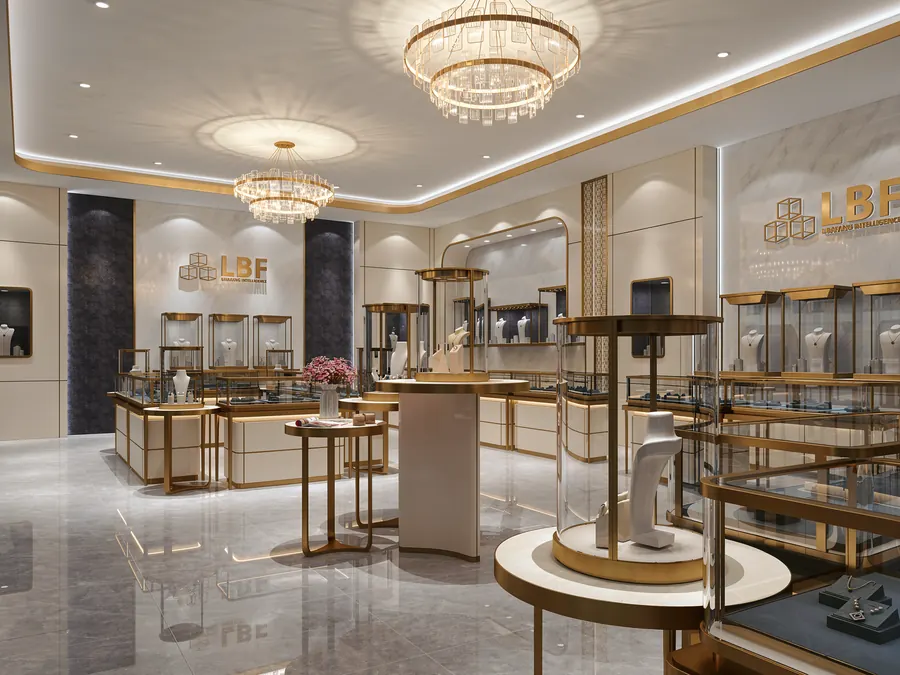
An eyewear cabinet is one of the hardest fixtures in retail to get right. A single pair of glasses occupies less than 150 mm of space, yet it must be readable from three meters, handled at 400 mm, and protected when the store closes. Most cabinets that underperform do so for three reasons: frames are packed too tightly to silhouette, mirrors are mounted flat against the back so nothing sells itself, and backstock is either hidden so well that staff cannot find it or exposed so openly that it undermines the luxury impression. This guide sets out the numbers we use when specifying luxury eyewear display cabinets for optical boutiques, department stores and multi-brand eyewear retail, covering frame spacing, mirror geometry and concealed storage.
Start with a spacing budget per frame
Spacing is the single variable that most affects perceived value. A shelf carrying 18 frames looks like a warehouse; the same shelf carrying 12 frames at the same price point reads as a curated collection. As a working rule, allow 85–110 mm of horizontal width per frame for temple-to-temple silhouette, plus a 40–60 mm gap between frames. For acetate frames averaging 140 mm wide, that means roughly 180–200 mm of shelf run per pair on a flat presentation shelf, and 12–14 pairs on a 2.4 m shelf. Metal and rimless frames can sit tighter, at 150–165 mm pitch, because their visual weight is lower.
Depth matters as much as width. Standard optical frames sit comfortably on a 150 mm deep shelf; sunglasses and wide sport wraps need 180–200 mm. If you plan to use a rear riser, add 40 mm of depth so the front row is not shadowed by the row behind it. Vertical pitch should be at least 130 mm between shelf surfaces, or 160 mm where you display on angled risers, so that a customer looking down at eye level can see the full lens shape of the second row.
Where space is genuinely constrained, use angled stepped risers rather than tighter horizontal spacing. A 3-step riser with 60 mm depth per step gives three readable rows in a 200 mm cabinet depth without making any individual frame look crowded.
Mirror placement: make the cabinet do the selling
Eyewear is tried on, so the mirror is not an accessory to the display — it is part of the sales fixture. In most retail layouts, a single large wall mirror at the end of an aisle serves four to six customers at once and forces people to walk away from the collection. Mirrors set into the cabinet keep the customer in place with the product.
Three placements work well, and each suits a different store format:
- Back-panel mirror strip (150–250 mm wide) running full height behind a column of frames — doubles apparent depth, costs little, and works in narrow cabinets where a full mirror would be too dominant.
- Integral side mirror on one end panel, minimum 400 × 1,600 mm — best for freestanding island cabinets where the mirror can also brighten the walkway.
- Recessed drawer-front mirror on pull-out display trays — ideal for high-value sunglasses in boutiques, since the mirror appears exactly when the frame is picked up.
Specify 4 mm or 5 mm silvered glass with a safety backing film rather than acrylic; acrylic scratches visibly within months at hand-contact height and degrades LED reflections. Keep mirror edges away from direct LED lines — place the strip at 50 mm offset from the lighting plane — or you will get a hot spot that visually competes with the frames.
Concealed storage that staff can actually use
Luxury eyewear cabinets usually need to hold 2.5 to 3 times the number of frames on display. A cabinet showing 48 frames should therefore include capacity for 120–140 additional pieces. Hiding all of that behind a fixed back panel creates the classic problem: display looks immaculate, staff spend ninety seconds finding a size, and the sale cools.
Four storage approaches solve this without compromising the front face:
- Pull-out tray banks behind the display shelf, on 450 mm full-extension runners, each tray holding 10–14 frames in felt-lined slots at 40 mm pitch.
- Locking base drawers at 180–220 mm height — useful for sunglasses and day-to-day stock, but keep the pull height below 900 mm so staff do not crouch.
- Concealed side cavity behind a removable or hinged end panel, opened with a magnetic push-latch — good for reserve stock and cleaning supplies.
- Upper lockable cabinet above 1,750 mm for overflow, seasonal stock and paperwork, out of customer reach and out of the main sightline.
For stock security at closing, a central locking bar across the drawer bank is more reliable than individual drawer locks and faster for staff. Specify minimum 18 mm plywood carcases with 1.5 mm steel reinforcement at the lock points if the cabinet will hold branded product overnight in a mall environment.
Lighting and materials for eyewear specifically
Eyewear display is unforgiving of lighting. Lenses catch reflections and acetate shows every fingerprint under a harsh beam, so aim for 300–500 lux at the frame surface with a CRI of 95 or above, and use 3000K–3500K where you want warmth without pushing acetate colors yellow. Line the shelf fronts with a recessed LED profile at a 45-degree angle rather than a straight-down strip; this lights the lens plane instead of the shelf edge.
For interiors, avoid pure white melamine — it flattens the product. Matte microfibre fabric in warm grey, deep taupe or soft sand reads as luxury and hides dust. Glass should be low-iron where visible through, and any branded hardware such as hinges, handles and lock covers should match within one finish across the fixture family.
Building the cabinet around your stock, not around a catalog
No two eyewear assortments space out the same way. A cabinet designed around 60 acetate frames on a 20-sqm store in one market will not suit a boutique carrying 140 metal and titanium frames with a strong sunglasses mix. The numbers above are starting points; the right specification comes from counting your actual top 40 frames — width, depth, temple thickness — and building the shelf and drawer geometry around them. Libafang Showcase Co., Ltd. works from frame measurements, store plans and lighting conditions to produce a dimensioned drawing before quoting, so the spacing, mirrors and concealed storage all resolve on paper first. Libafang manufactures custom display showcases and eyewear cabinets in Guangzhou for optical boutiques, department stores, museums and luxury retail clients in more than 30 countries, with full export documentation and crating.
Request a free design and quote for your own luxury eyewear display cabinets — send your frame dimensions, a plan of the retail space and your lighting notes, and we will return a dimensioned layout and price with the mirror and storage plan included.