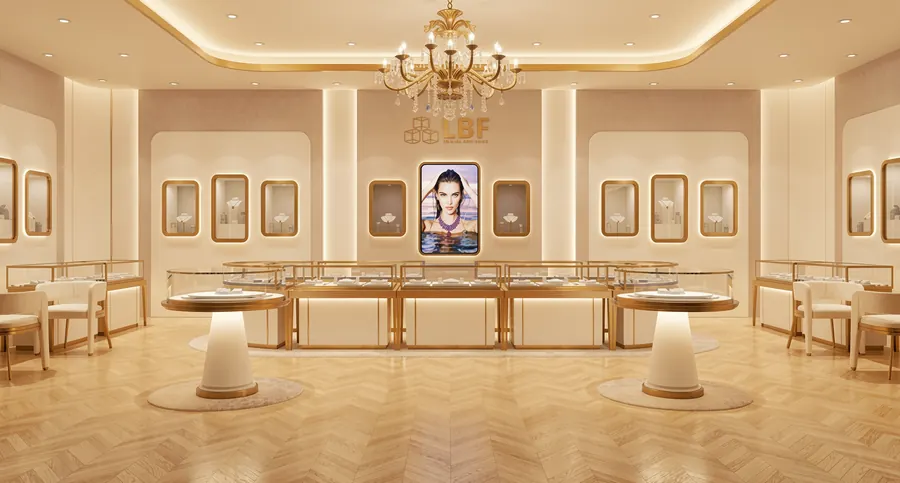
Walk into most luxury boutiques and you will see two display philosophies side by side: open shelving where customers can reach in, and enclosed cases behind glass. The choice is not cosmetic. It shapes browsing behaviour, security, cleaning routines and even how many pieces a client asks to try on. For a 20–60 sqm boutique, a typical fit-out uses roughly 60–70% enclosed display and 30–40% open shelving, but those ratios should follow your product mix, not habit. This guide breaks down where each format earns its place, so you can specify a layout that sells rather than just looks good on opening day.
How the Two Formats Change Customer Behaviour
Enclosed cases create a deliberate threshold. A customer points, staff unlock a door, and the interaction becomes a small ceremony. That suits high-value items — a $15,000 watch or a 2-carat solitaire — where the act of presentation supports the price. Studies of retail conversion consistently show that assisted viewing increases average transaction value but reduces the number of items a customer inspects per visit, often by 30–50% compared with self-service formats.
Open shelving removes friction. A shopper can pick up a $300 silver bracelet, compare two finishes and put them back without waiting. For entry-price and mid-price ranges, this lifts units per transaction and shortens dwell time per item. The trade-off is control: every piece on an open shelf has to survive handling, and the story your luxury boutique display shelving tells is one of access and confidence rather than exclusivity.
Security, Loss Control and Insurance Realities
Enclosed cases with lockable sliding or hinged doors are the default for anything above roughly $1,000 per unit. Laminated 6–8 mm glass, concealed locks and alarm tape are standard at the higher end. If your insurer requires overnight storage in a safe, the case itself becomes a daytime display tool, not a vault — plan a 5–10 minute closing routine per case.
Open shelving relies on layout and staff positioning. Practical measures include placing open shelving within 4–6 metres of a staffed counter, using shallow shelf depths of 250–300 mm so items cannot be swept into a bag, and keeping high-value pieces on the upper 40% of the fixture. Some boutiques combine open shelving with a low-profile sensor loop; unrehearsed, this often triggers false alarms, so test it for a week before relying on it.
Cleaning, Maintenance and Light Management
Glass is the hidden operating cost. An enclosed case needs interior glass cleaning every 1–2 days, plus weekly dust removal around seals and tracks. Open shelving collects dust directly on product trays and needs a light daily wipe and a deeper clean every 7–10 days depending on footfall.
Lighting behaves differently too. Inside a sealed case, LED strips at 3000–3500K with a CRI above 90 give consistent colour, and heat is contained but manageable with 12V low-voltage strips. On open shelves, daylight and store ambience change the perceived colour of metals and stones through the day, so use dimmable fixtures and avoid shelf edges that cast shadows across the product face.
Where Each Format Works Best — a Practical Checklist
Use this as a starting specification when laying out a new boutique or refit:
- Enclosed cases: fine jewelry above $1,000, loose stones, watches, and any item requiring certification or a sales script.
- Enclosed cases: high-theft categories and stores with fewer than two staff on the floor.
- Open shelving: entry-price jewelry, fashion accessories, fragrance, leather goods and gift ranges under $500.
- Open shelving: window ledges and wall niches where the goal is visual rhythm rather than handling.
- Hybrid: a low enclosed counter at the entrance, backed by open wall shelving, gives browsing access and a natural assisted-sales zone within 3 metres.
Design, Materials and Unit Costs
Enclosed cases cost more per linear metre because of glass, locks, lighting and joinery tolerance. A typical custom glass-top case runs 20–40% higher than an open shelving bay of the same width. Open shelving, by contrast, is faster to produce and easier to reconfigure — useful if your range changes seasonally.
Material choices matter in both formats. For open shelving, use 18–25 mm board with a durable matte finish; high-gloss surfaces show fingerprints within a day. For enclosed cases, specify 6 mm tempered or laminated glass for shelves and 8 mm for doors, and allow 2–3 mm clearance on sliding tracks so humid months do not cause binding. Lighting should sit at the front edge, not the back, so the product face is lit rather than the wall behind it.
At Libafang, we build both formats in the same Guangzhou workshop, which means a mixed layout can be produced as one coordinated order with consistent finishes, hardware and lead times — typically 25–35 days for production plus shipping, depending on specification.
Making the Decision
Start with your price architecture. If more than half your stock sits above $1,000, enclosed cases should dominate and open shelving should serve windows and entry ranges. If your business is built on volume under $500, open shelving earns its space and enclosed cases become a focal point rather than the default. Either way, match your luxury boutique display shelving to how your staff actually sell, and budget for the cleaning and staffing that each format demands.
If you are planning a new boutique, a refit or a museum retail space, send us your floor plan and product mix. Libafang offers a free design and quote, including layout drawings, material samples and a line-item cost breakdown, so you can compare open and enclosed options before committing.