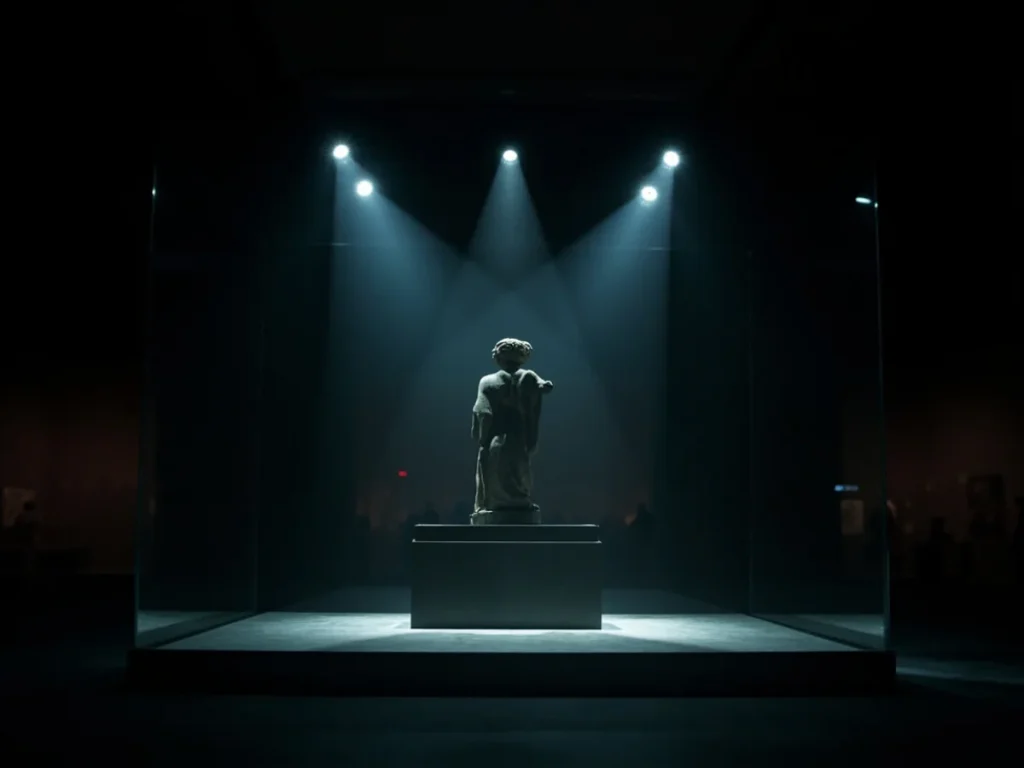
Two cabinets can be built from the same 1.2 mm stainless steel frame, share identical dimensions and glass, and still feel like completely different products on the sales floor. The difference is usually the finish. For luxury display cabinet finishes, buyers most often choose between brushed and polished metal, and the decision affects everything from how jewellery reads under track lighting to how soon a salesperson has to reach for a microfibre cloth. This guide breaks down both options in practical terms so you can specify with confidence.
What Brushed and Polished Finishes Actually Are
A brushed finish is produced by running an abrasive belt or Scotch-Brite wheel across the metal in one direction, creating fine parallel grain lines. Common grades include hairline (very fine, roughly 240–320 grit equivalent) and satin (slightly coarser, 180–220 grit). Polished finishes go the opposite way: progressively finer abrasives remove the grain until the surface reaches a mirror level, typically Ra 0.05–0.2 µm for a true mirror polish and Ra 0.3–0.5 µm for a semi-polish.
In both cases the base material matters. For high-end retail, 304 stainless steel is the standard; 316 is worth the 15–25% premium in coastal showrooms or museums with stringent air-quality requirements. Brass and bronze are usually lacquered after finishing to prevent oxidation, and that lacquer layer changes the maintenance story considerably.
How Each Finish Performs in a Retail Environment
Fingerprints are the single most common complaint with metal display cabinets. A mirror-polished surface shows every touch immediately, and in a busy jewellery store a polished pull or frame edge may need wiping several times per day. A brushed finish hides fingerprints far better because the grain scatters light and breaks up smudges; a quick wipe once daily is often enough. If your staff turnover is high or cleaning discipline is inconsistent, brushed is the safer choice.
Scratch visibility follows the same logic. A single hairline scratch on mirror polish is glaring under 3000K spotlights, whereas a hairline-grain brush tends to mask minor abrasions. Conversely, polished surfaces are easier to restore spot repairs on — a small area can be re-polished by hand — while a brushed panel needs careful re-graining or the repair shows as a dull patch.
Light, Colour and Product Presentation
Polished metal acts like a mirror, bouncing spotlight beams and product reflections back into the customer’s eye. For diamond and watch displays this can add real sparkle, but uncontrolled reflections can also create glare on glass and distract from the merchandise. Designers often solve this by polishing only the frame reveal and keeping larger panels brushed, or by using a semi-polish at Ra 0.3–0.4 µm.
Brushed surfaces read as matte and calm. They reflect approximately 40–60% less specular light than mirror polish, which makes them ideal for museums, art retail and any setting where the cabinet should step back and let the object speak. Warm brass tones finished satin also photograph extremely well for e-commerce and lookbooks.
Cost, Lead Time and Manufacturing Considerations
The finishing step is a modest share of total cabinet cost, but the gap between the two options is real. As a rough guide, expect a mirror polish to add 10–18% to the metal finishing line compared with a standard hairline brush, largely because polishing requires more labour passes and stricter inspection. Lead time may extend by 3–5 working days per batch. Both finishes are achievable on laser-cut and welded frames, but sharp internal corners are far more forgiving in brushed grain than in mirror polish, where every weld must be dressed to an invisible standard.
- Brushed: best fingerprint and scratch tolerance, lower cost, fast lead time, matte appearance.
- Polished: maximum reflectivity and perceived luxury, higher maintenance, higher cost and stricter QC.
- Semi-polish: a practical middle ground for high-traffic areas and large panels.
- Lacquered brass or bronze: warm tone with reduced tarnish, but treat cleaning products with care.
- PVD coatings: add colour and hardness (often 2–3× the abrasion resistance of bare stainless) at roughly 20–30% extra cost.
Specification Tips for Mixed Finishes
Most luxury display cabinet finishes in premium retail are actually hybrids. A common approach is a brushed body with polished edge reveals, or a mirror-polished interior back panel behind glass shelves to amplify light. Be explicit in your drawings: state the grain direction, the target Ra value, and whether welds must be fully dressed. Ask for physical finish samples rather than photos, since lighting on a phone screen distorts reflectivity. Specify the cleaning regime at handover — a pH-neutral cleaner and a dedicated microfibre cloth for polished surfaces, and a non-abrasive wipe with the grain for brushed.
Also consider the surrounding architecture. High-gloss stone floors and mirror walls multiply reflections, so a polished cabinet in that context can become visually noisy; a brushed finish restores balance. Conversely, a matte-walled boutique may benefit from one polished accent to add life.
Libafang manufactures custom display showcases and cabinets in Guangzhou for jewellery stores, watch boutiques, museums and luxury retail clients in more than 30 countries. Our team can produce brushed, mirror-polished and semi-polished stainless steel, lacquered brass and PVD finishes to your drawings or ours. Tell us your project size and finish preference, and request a free design and quote — we will send a layout, finish samples and an itemised price within a few working days.