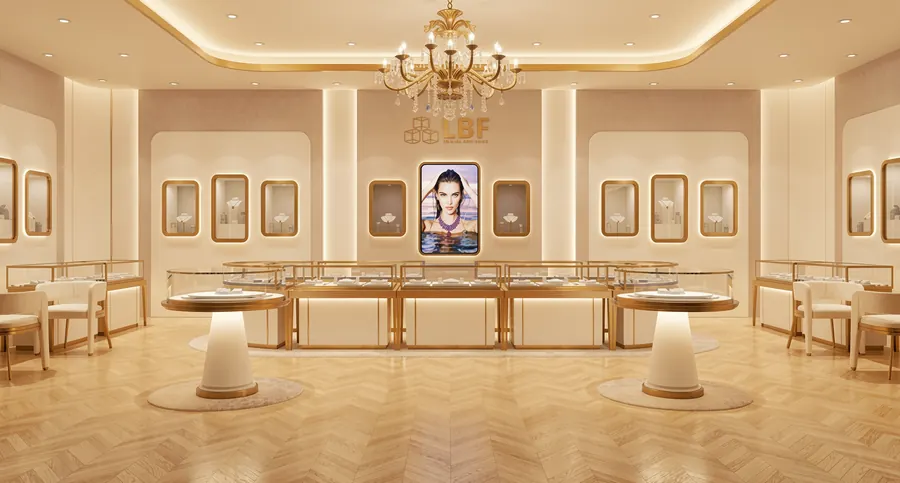
A jewelry or watch window is the most expensive square meter in a boutique: it decides whether a passerby stops or walks on. But that same window is also a harsh environment: direct sun, glasshouse heat, UV bleaching and a merchandising calendar that changes every 4 to 8 weeks. Most disappointing display cases fail not because of weak craftsmanship but because the brief ignored those three forces. This guide lays out a planning method for luxury boutique window display cases that addresses sunlight, heat and display changes before the first drawing is approved — with practical figures you can put into a specification.
Start with a sun and heat audit of the window bay
Before choosing materials, measure the window’s exposure for a full day in summer and again in winter when possible. Record orientation, the number of hours of direct sun, and the temperature at the top of the display area at 2 pm to 4 pm, which is usually the worst moment. Useful reference points: a south or west-facing bay in Guangzhou can reach 45–55 °C inside the window cavity on a summer afternoon while the shop floor stays at 24 °C. Under low-e glass, surface temperatures on a dark plinth can still exceed 50 °C.
Those numbers matter because heat does not only spoil products — it distorts cases. MDF, lacquer, acrylic and even thin leather linings expand at different rates. A 600 mm acrylic riser can move 1–2 mm over a 25 °C swing, which is enough to crack seams or lift a glued edge after one season. Plan for an air gap of at least 40 mm between the glass and the back of the case, and prefer a plinth that lifts the showcase 150–200 mm above the sill so cooler floor air can circulate under it.
Specify glass, coatings and lighting with UV in mind
Ultraviolet light fades silk, leather straps, natural gemstones and printed graphics. Standard float glass blocks some UV, but laminated glass with a UV-filtering interlayer can block over 99% of radiation in the 300–380 nm range. An anti-reflective coating is also worth the extra cost in a bright window: it reduces reflection from 8% to roughly 1%, which helps customers actually see the product instead of the street behind them.
Inside the case, choose LED lighting with a CRI of at least 90 and a color temperature between 3000 K and 3500 K for gold and precious stones. Warm lights above 4000 K can make yellow gold look green-grey. Keep heat-generating fixtures out of the case body or specify a separate LED channel in the frame; a 20 W spotlight placed inside a sealed 400 mm case can add 5–8 °C. Follow these rules when building the lighting schedule:
- Use 3000–3500 K LEDs with CRI 90+ for gemstones and gold, and check color rendering against the actual products.
- Keep lamps at least 100 mm from product surfaces to avoid local hotspots and lens flare on glass.
- Set timers so the window lighting operates only during trading hours, cutting heat load by about 30%.
- Choose dimmable drivers rated for ambient temperatures above 45 °C in window locations.
- Test at noon and at 8 pm, because daylight and artificial light change the perceived color dramatically.
Use materials that tolerate heat cycling and humidity
For luxury boutique window display cases, the most reliable construction uses powder-coated aluminum frames, tempered or laminated low-iron glass, and interior linings that are stable under heat. In coastal and humid regions, stainless steel hardware should be 304 or 316 grade; ordinary zinc-plated fittings can show corrosion within a year in a humid window environment. Solid wood plinths look superb but need at least two coats of a heat-resistant sealer and should not sit directly against glass. If you need a leather or suede look, specify a PU or microfiber with a stated heat resistance, or a removable leather insert that can be replaced without rebuilding the case.
Design for the real merchandising cycle
Most boutiques change their window every 4 to 8 weeks, and a major season change may involve entirely different product sizes. A case that looks perfect for 18 mm rings fails when it needs to hold a 45 mm dive watch or a necklace bust. Build adjustable shelving in 25 mm increments, use modular risers and keep at least 20% of interior height as spare clearance. For a typical 1200 mm wide window case, a depth of 400–450 mm accommodates most jewelry, while watch displays often need 300–350 mm; note that in the brief.
Consider access too. Hinged front glass or a removable sliding panel adds cost, but staff can restore a window in 20 minutes rather than 2 hours with a tool kit. Cable routing should run through a corner post with a 25 mm channel so lighting changes do not require dismantling the showcase.
Set a realistic maintenance and budget schedule
Window cases are exposed, so maintenance is part of the plan. A quarterly check of seals, silicone and hinge alignment takes under an hour per case. Budget roughly 3–5% of the case cost per year for parts such as lamps, liners and gaskets. When comparing quotes, ask for the glass specification, LED data sheet, temperature rating of the finish and a drawing showing air gaps. Libafang builds custom showcases for jewelry, watch, museum and luxury retail projects and is used to exporting to clients in 30+ countries, so specifications can be matched to local electrical and safety standards. A clear written brief — dimensions, sun exposure, product ranges and change frequency — costs nothing at the start and saves the most money later.
Final checklist before you approve the drawing
Confirm the sun and heat audit results, the glass and UV specification, LED color temperature and CRI, an air gap of at least 40 mm, a plinth height of 150–200 mm, adjustable interiors and tool-free access. If the drawing answers all of these, the window will hold its appearance through many merchandising seasons rather than failing in the first. If you would like a second opinion on an existing design, or need a tailored proposal for luxury boutique window display cases, request a free design and quote from Libafang and share your window bay measurements and product range.