Specifying museum display cases for a new exhibition is one of the few decisions that affects every object on the floor plan. Get it right and the cases quietly protect fragile artifacts, stay within the loan agreement conditions, and let visitors see details they would otherwise miss. Get it wrong and you face compressed schedules, conditional loans refused at the last minute, and cases that fog, vibrate or cannot be retrofitted. This guide walks you through the decisions curators, exhibition designers and registrars actually have to make — in the order they usually need to make them — with realistic numbers to use as starting points.
Start with the collection, not with the case
Before requesting a single price, classify every object by material and risk. Bronze sculpture, oil paintings and ceramic vessels are broadly stable at 45–55% relative humidity (RH) and 18–22°C. The difficult groups are the ones that drive cost: polychrome wood wants roughly 50–55% RH but is sensitive to rapid change; paper and parchment prefer 45–55% RH but are very sensitive to light exposure; metals tolerate lower RH (often under 40%) but corrode above about 55%; textiles and natural-history specimens typically sit between 45% and 55% at lower light levels. Many lenders now state tolerances in loan contracts, commonly ±3–5% RH and ±2°C once an object is installed.
Group objects by required environment, not by gallery aesthetics. A single 40-object exhibition can easily need three or four distinct microclimates: airtight cases for mixed organics, a non-sealed case with passive silica control for robust ceramics, and a pocket display for works on paper rotating every 3–6 months. Write down, per case, the material classes, the maximum single-object weight, the largest object dimensions including mounts and packing clearance, and the loan-mandated tolerances. That one-page schedule will determine 80% of your specification.
Decide on climate control and sealing level
The key question is whether a case must hold a setpoint with no power or maintenance service. There are three practical tiers:
- Well-sealed case with passive buffering — gaskets, no cable penetrations, 30–60 kg of conditioned silica gel per cubic metre of internal air. Achieves stable RH for weeks to months in most galleries; suitable for wood, ceramics and many mixed collections.
- Airtight case with active conditioning — mechanical humidity control or conditioned air supply, plus a small recirculation fan. Typically reaches ±2% RH control and is what most lenders expect for sensitive organics and composite objects.
- Microclimate pocket or vitrine insert — passive cassette modules or a sealed acrylic hood inside the main case, useful for one or two highly sensitive objects and for rotating works on paper.
Ask suppliers for a leakage or decay test result rather than just the words “airtight”. A useful benchmark: a well-built sealed vitrine should hold RH within 5% over 24 hours in an uncontrolled gallery test. Budget for the running cost of conditioning too — a 4 m³ conditioned case may draw 50–150 W and needs annual filter or sensor calibration.
Specify glazing, security and physical protection
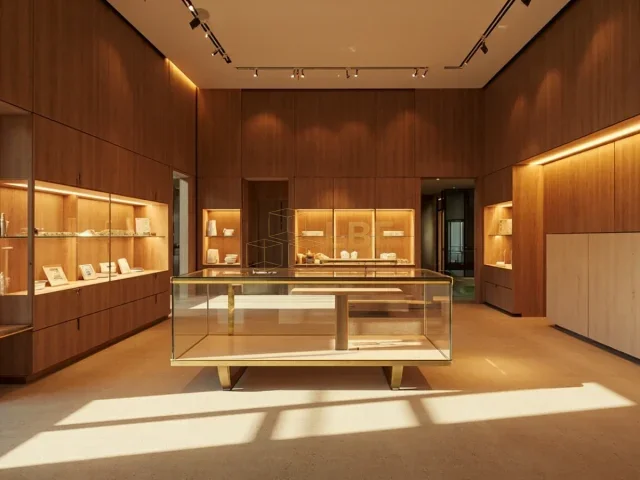
Glazing is where museums lose the most sleep. Low-iron laminated glass of 8–10 mm is now standard for freestanding and wall cases: it cuts the green cast of ordinary float glass, blocks more than 98% of UV below 380 nm, and holds together if struck. For high-value objects and crowded public galleries, specify laminated glass with a PVB or SentryGlas interlayer and a mounting that resists forced entry; frameless lids and simple corner joints are common weak points.
Match security hardware to your site, not to a catalogue. Typical options include hidden locks, tamper-resistant fixings, alarmed glass, vibration or tilt sensors and case-in-case pockets for the highest-value items. For outdoor or transit-adjacent galleries, add a sealed base and consider 12 mm laminated glass with a reinforced frame. Also think about the human factors: staff need to open cases for cleaning and object swaps without tools where the schedule requires daily or weekly access, and case heights should sit within the 900–1200 mm viewing band for labels and object sightlines.
Get daylight and LED lighting right — and keep heat out
Light management is a conservation decision before it is a design decision. As a working rule, target 50 lux and under 50,000 cumulative lux-hours per year for the most light-sensitive works on paper and textiles, around 150–200 lux for polychrome wood and paintings, and up to 300 lux for robust stone, metal and ceramics. Total UV output should stay below 10 µW/lumen and ideally at zero by using LED with UV filtration.
Inside the case, use remote LED sources with fibre-optic or lensed delivery where possible, or sealed internal LED modules rated for the case climate; heat load inside an airtight vitrine quickly destabilises RH and can create convection cells that deposit dust on upward-facing surfaces. Keep light sources at least 150 mm from objects and fittings above 25 lux-per-watt heat budgets, and plan for dimming channels and door-contact cut-offs so light only runs when the case is closed. Have an engineer confirm the temperature rise inside the case during a full day’s lighting before signing off the design.
Plan access, fabrication and delivery before you sign
Case selection fails most often in logistics, not in conservation theory. Work through this sequence with the manufacturer early:
- Fix floor plan positions, internal depths (typically 500–800 mm for object plus mount plus 100 mm clearance) and heights, including any plinth or integrated base.
- Confirm door type: hinged, sliding, lift-off or removable front, and the sweep required to open safely in a gallery with visitors present.
- Agree tolerance for movement joints, floor level differences and any ramp or plinth interface.
- Approve materials with odour and off-gassing data — powder-coated steel, aluminium, low-emission sealants, and archival-quality case linings — and request a low-emission bake-out or air-out period of 2–4 weeks before artifacts go in.
- Define factory acceptance tests: sealing test, lock function, glass integrity, light levels, noise of any fans, and crate/freight dimensions against gallery doors and lifts.
- Book installation and post-install stabilisation time — allow 3–7 days of RH logging before the first object enters.
Lead times matter. For custom museum display cases, expect roughly 8–12 weeks from approved drawings to factory completion for a moderate order, plus shipping and installation. Complex airtight or conditioned cases can push to 14–16 weeks, so brief the manufacturer before the loan agreements are finalised, not after.
A practical budget and supplier checklist
As a rough 2024–2025 planning range, a standard freestanding sealed vitrine with low-iron laminated glass is commonly quoted at USD 1,200–3,000, a wall-mounted or recessed case at USD 800–2,500, and a conditioned airtight case with active RH control at USD 5,000–15,000 and up, depending on size and controls. Add 10–15% of case cost for lighting, and a further contingency for sensors, mounting and shipping. If you are comparing suppliers, ask three questions: can they share a sealing test report, can they supply low-emission material certificates, and who handles installation and on-site calibration?