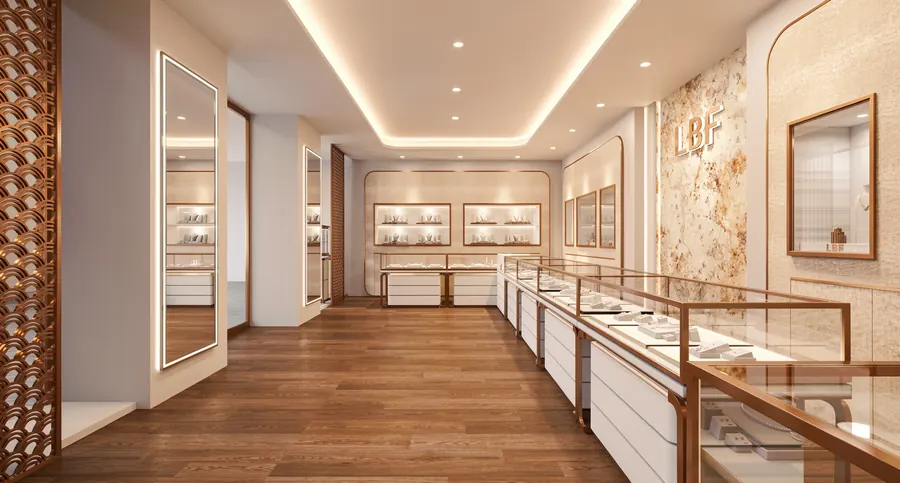
Walk into any jewelry store and you will notice the displays before you notice the doors. Yet the door is the single part of a jewelry showcase that staff physically interact with dozens of times a day. A beautiful case with the wrong door design costs your team three to five seconds per open-and-close cycle, adds fingerprints near the glass edges, and in the worst case limits what you can actually place on the shelf. For buyers specifying a jewelry showcase door design, sliding and hinged doors are the two dominant choices, and the right answer depends on counter position, traffic flow, product mix and security habits. This guide compares them on the points that matter in daily operation.
How the two door types actually work
Hinged doors pivot on concealed or exposed hinges, usually along the front face or the top edge of a counter case. A full-height front hinge can open 90 to 110 degrees and gives an unobstructed rectangular opening for grabbing a tray or a single ring stand. Sliding doors travel on tracks, typically top-hung with nylon or steel rollers, and either bypass each other inside the frame or slide into a pocket. A two-panel bypass is common on counters from 900 mm to 1800 mm wide, while a three-panel or pocket configuration appears on longer showcases above 1800 mm.
The mechanical difference drives everything else: hinged doors need swing clearance in front of the case, while sliding doors need lateral track length and a cleaner path along the glass face.
Access width and staff workflow
For a sales associate reaching into a standard 600 mm deep counter, the usable opening matters more than the door style. A single hinged door on a 1200 mm case may only give 550 to 600 mm of clear access — enough for a tray but awkward when you need to reach the back corners. Double hinged doors on the same case open to roughly 1100 mm and feel far more spacious, but the two leaves then intrude into the aisle. Sliding doors on a 1200 mm case typically provide 580 to 600 mm clear at any one time, yet the panels can overlap so you can slide them fully to one side and expose nearly the full length.
Think about how your team works before you choose:
- High-frequency single-item access (a ring, a watch, a single pendant): hinged doors win because one-handed opening is fast and the door stays where you leave it.
- Tray and collection access (bridal sets, seasonal collections): sliding doors win because the full opening exposes the whole counter and nothing swings into a customer’s personal space.
- Narrow aisles under 900 mm: sliding doors are the safer specification; hinged leaves can block the walking path and force sales staff to step sideways.
- Corner or peninsula counters: a hinged door at one end plus a fixed panel usually costs less and opens more cleanly than an L-shaped sliding track.
Security and daily discipline
Both door types can be locked, but the way staff handle them differs. Hinged doors with a central lock or a cam lock and two-point locking are simple to audit — a glance tells you if the case is closed. Sliding doors offer a smooth, quiet action that is difficult to force, especially with a top-hung system and a concealed bottom guide, but a partly open bypass panel can look shut from a distance. If your store relies on visual checks during busy periods, specify a slide with a positive close and a visible lock indicator, or add a central locking bar across the sliding panels.
Glass specification matters as much as the mechanism. Most jewelry counters use 6 mm to 8 mm tempered glass for door panels, with laminated glass where impact resistance and anti-smash performance are required. Heavier panels — particularly 8 mm or laminated 6.38 mm — are best on top-hung sliding tracks rated for the load, while hinged doors need hinges and frames rated for the panel weight plus a safety margin.
Cleaning, maintenance and long-term cost
Hinged doors are mechanically simple: hinges, a stop, a lock. Occasional adjustment of a hinge screw keeps alignment, and there are no tracks to collect dust. Sliding doors need a clean track. In a retail environment with daily polishing cloths and lint, the lower guide and rollers benefit from a wipe-down every week and a light check every six months. A quality top-hung roller set typically runs quietly for years, but cheap rollers on thin tracks rattle and stick within 12 to 18 months of daily use — a false economy on a counter that opens 100 or more times a day.
On cost, a basic hinged door is usually the lower-priced option. Sliding systems add track hardware and precision alignment, so expect a modest increase per case, offset in busy stores by faster tray access and fewer dropped or scuffed items. For museums or climate-controlled displays, the sealed frame and gasket detail matter more than the door type; ask your manufacturer to confirm the gasket and closure quality rather than assuming it.
Matching the door to counter position and store layout
Sales floor geometry should decide the specification. A wall-run counter with the associate behind it and customers in front works well with sliding doors: the salesperson slides a panel, lifts a tray, and closes it without leaning across the glass. An island or freestanding case with walk-around access often suits double hinged doors on the customer-facing side because the swing is contained within the staff zone. For a watch boutique with tall, narrow cases, a top-hinged door that lifts upward can be better than either front option, especially where floor space is tight.
Also consider collection day. If deliveries arrive in trays and staff need to load 40 to 60 pieces quickly, a wide sliding opening saves cumulative minutes every week. If your team mostly handles single high-value pieces, a hinged door with a controlled soft-close action reduces the risk of a panel swinging into a display stand.
Specifying with confidence
There is no universal winner. Sliding doors suit long counters, narrow aisles, tray-heavy workflows and quiet luxury interiors where hardware should disappear. Hinged doors suit compact cases, corner units, quick single-item access and stores that want the simplest possible locking audit. The most reliable path is to ask a display manufacturer to model both options on your actual counter drawings, with a clear opening dimension and a roller or hinge specification in writing. Libafang Showcase Co., Ltd. builds custom jewelry, watch, museum and luxury retail showcases in Guangzhou and exports to more than 30 countries, so the team has seen how door choices perform over years of daily retail use. Share your counter layout and product mix, and the team can recommend a door configuration, glass build and lock detail that fits the way your staff actually works.
Ready to settle the door question on your next store fit-out? Request a free design and quote from Libafang and compare sliding and hinged options side by side before you commit.