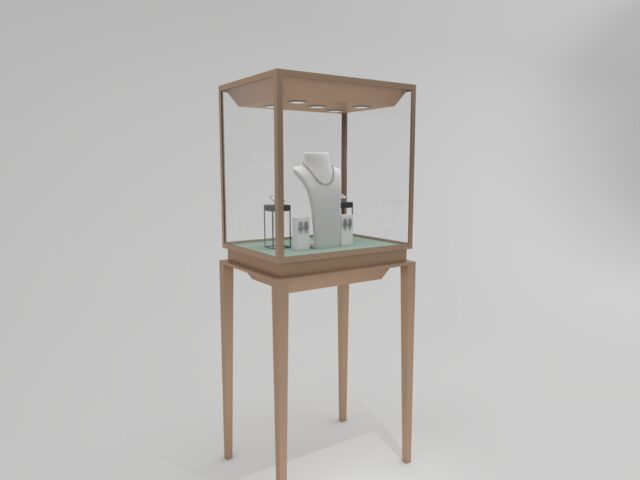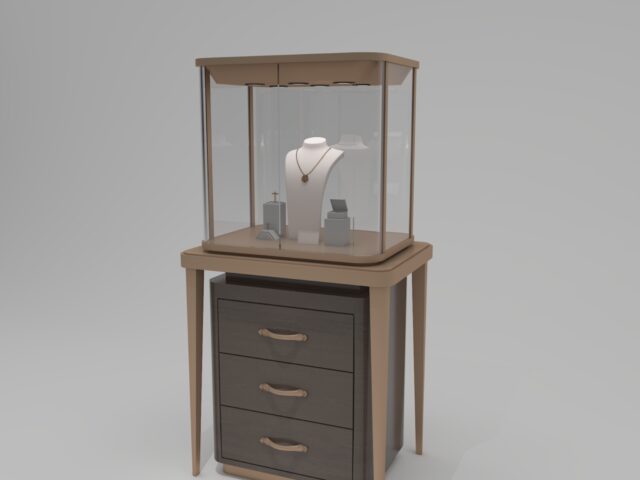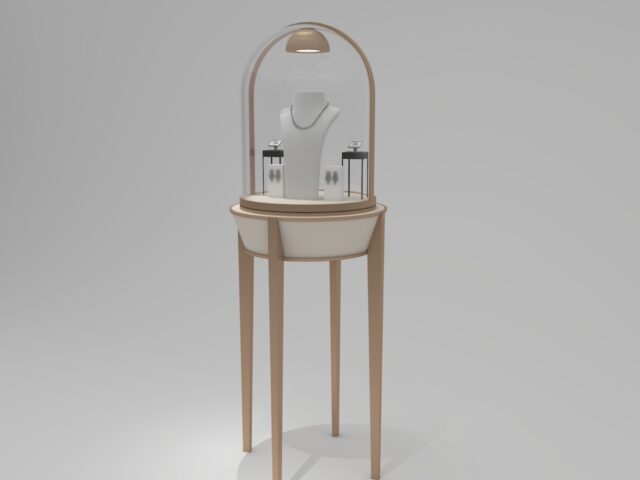
Glass objects are among the most demanding pieces to display. They are heavy yet fragile, transparent yet reflective, and their visual appeal often depends on edges that disappear against a busy background. A museum glass object display case must solve three problems at once: support the object without stress points, control reflections so the viewer sees the glass rather than the room, and make edges legible through contrast and lighting. This article gives practical specifications for each, drawn from custom case manufacturing for museums and luxury retail.
Supporting Glass Objects Without Stress Points
Glass fails at contact points. A 5 kg vase resting on a hard surface concentrates load on a few square millimetres, and vibration or thermal movement can initiate cracks. Effective supports distribute weight and eliminate hard contacts. For free-standing vessels, a machined acrylic or conservation-grade foam cradle shaped to the base profile is standard; the contact area should be at least 30% of the base footprint. For stemmed pieces, a padded saddle under the foot with a secondary stabiliser at the bowl reduces cantilever stress. Never support a glass object by its rim or handle—these are the weakest points. For flat glass panels or platters, use a full-surface support with a slight backward rake of 5–10 degrees, secured with unobtrusive acrylic clips lined with felt. All materials in contact with the object should be inert: no PVC, no untreated wood, no adhesive-backed felts that off-gas. Specify polyethylene foam ( Plastazote LD45 or equivalent) or washed cotton jersey over Ethafoam.
Reflections: Glazing, Angle, and Internal Light Control
Reflections are the most common complaint in glass-object displays. The fix is a combination of glazing choice, case geometry, and lighting placement. Anti-reflective glass (AR-coated, with reflectance below 1% compared to 8% for standard float glass) is the single most effective upgrade for museum glass object display cases. Where budget allows, laminated AR glass with UV filtering (blocking 98%+ below 400 nm) protects both object and viewer experience. Case geometry matters: a vertical front pane reflects the viewer’s body; tilting the front pane 5–7 degrees downward directs reflections to the floor. Internal lighting should never face the front glass. Use top-down or rear-corner LED strips with diffusers, and keep the light source at least 150 mm behind the front pane. For highly reflective silvered or mirrored glass objects, add a matte dark interior back panel to absorb stray light.
Edge Visibility: Contrast, Backlighting, and Backgrounds
Clear glass edges vanish against light backgrounds and read as black lines against dark ones. The goal is controlled contrast. For cut or polished edges, a mid-tone background (18–25% grey or a warm taupe) makes edges visible without harshness. For engraved or frosted edges, raking light from a low angle (15–20 degrees above horizontal) grazes the surface and reveals texture. Backlighting works for coloured or opaline glass but must be diffused—direct backlight creates hotspots and flattens form. Use a 50–100 mm air gap between the object and the back panel, with an LED panel at 3000–3500 K and a diffuser of at least 70% transmission. Avoid pure white interiors for clear glass; they erase edges and make the object look like a silhouette.
Environmental Sealing and Access
Glass is chemically stable but vulnerable to pollutants and condensation. A well-sealed case with a gasket (silicone or EPDM) and a buffered silica gel tray maintains 40–50% RH with minimal intervention. For museum-grade cases, specify a leak rate below 0.5 air exchanges per day; this extends silica gel life from weeks to months. Access should be via a front or top door with concealed hinges and a lock, and the door swing must not require moving the object. For large or heavy pieces, a removable top or a sliding front panel is preferable. Include a 20–30 mm plinth gap for air circulation if the case is not sealed.
Practical Specification Checklist
- Glazing: AR-coated laminated glass, 6–8 mm, UV filter ≥98% below 400 nm.
- Support: custom-machined acrylic or Plastazote LD45 cradle, contact area ≥30% of base.
- Interior finish: matte, mid-grey (18–25% reflectance) back panel; no pure white.
- Lighting: 3000–3500 K LED, CRI ≥95, diffused, positioned ≥150 mm behind front glass.
- Sealing: EPDM gasket, silica gel tray, target ≤0.5 air exchanges/day.
- Access: front or top door with lock, swing clear of object; removable top for heavy pieces.
- Base: level feet with ±5 mm adjustment; load rating ≥3× object weight.
Libafang manufactures custom museum glass object display cases to these specifications, with in-house acrylic forming, LED integration, and AR glazing options. Each case is built to the object’s dimensions and weight, with support cradles produced from 3D scans where needed. For museums and luxury retail projects, we provide shop drawings and material samples before production.
Ready to specify a case for your glass collection? Request a free design and quote from Libafang—send us your object dimensions, weight, and display environment, and we will return a detailed proposal within five working days.