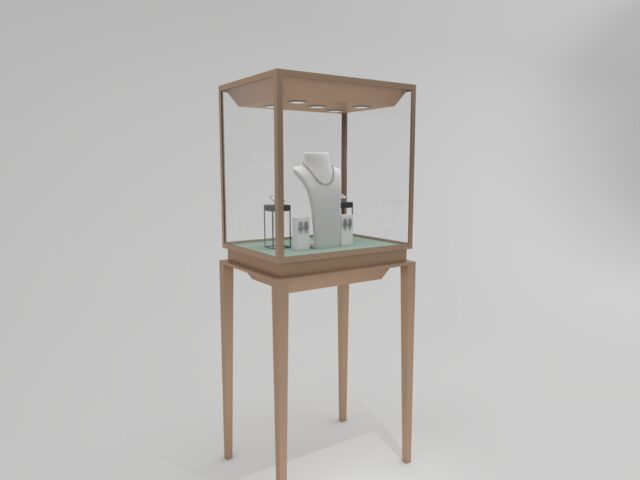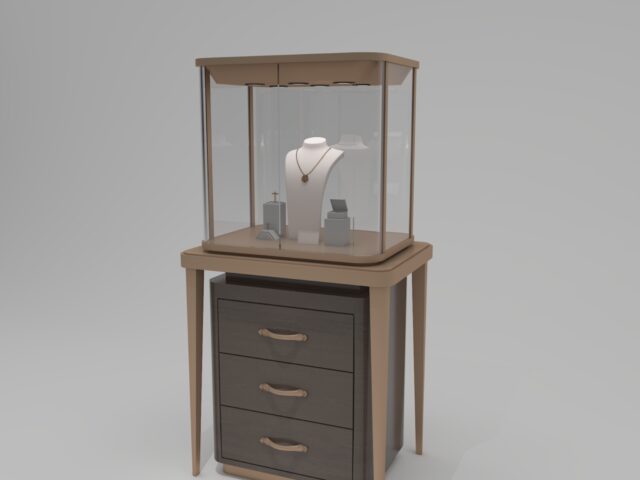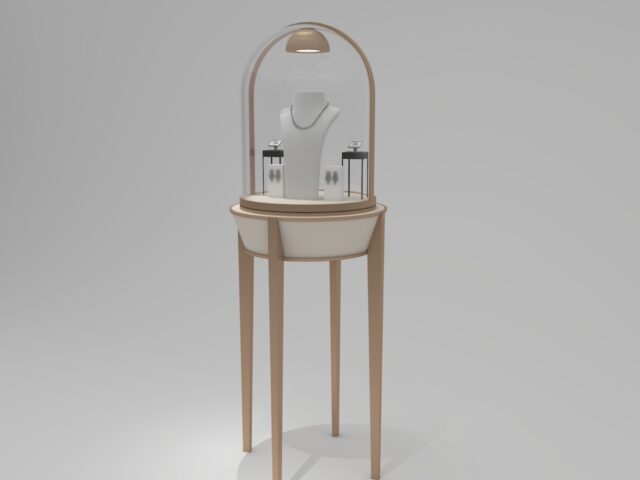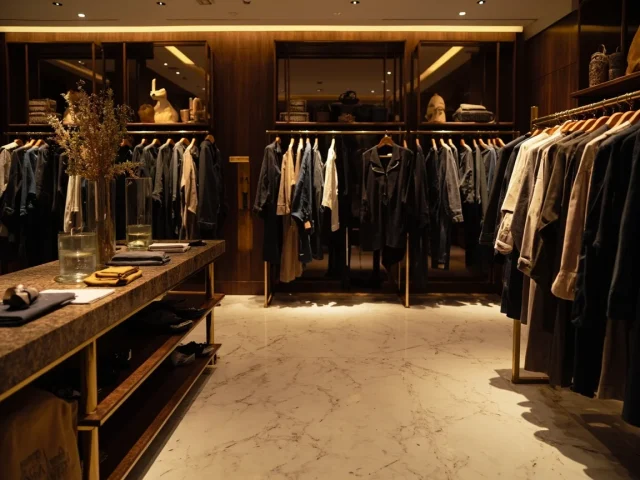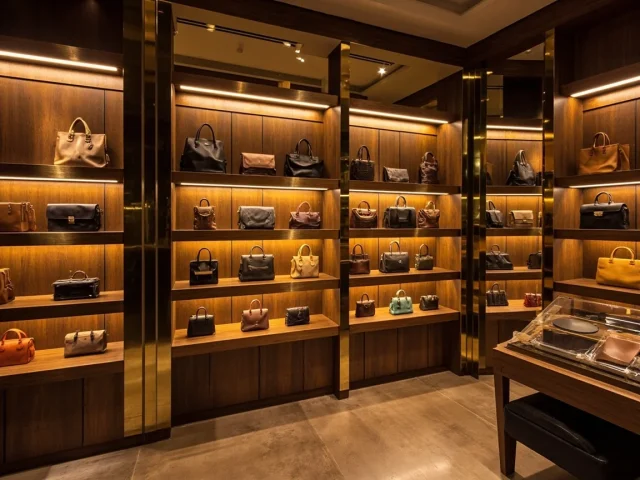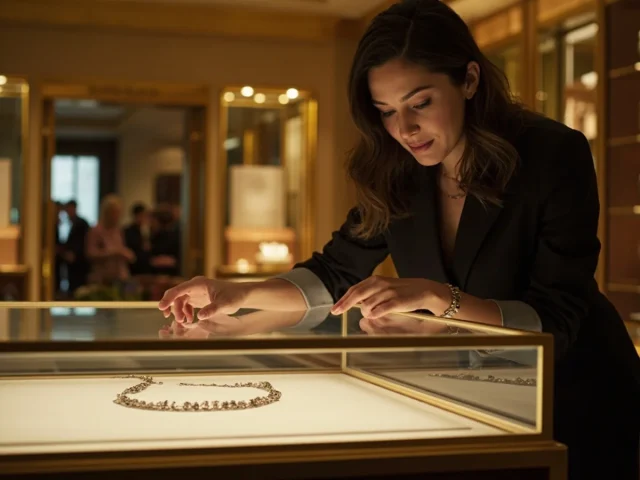
A pendant only sells when the customer can see the whole thing: the bail, the chain, the way the stone catches light at the end of a 45 cm or 50 cm drop. But at the densities most stores need to be commercially viable — 30, 50, even 80 pieces in one case — chain visibility is usually the first thing sacrificed. Pieces tangle, the top half of the case goes dark, and sales staff end up lifting trays just to show a customer what is actually on display. Pendant display showcases solve this by treating vertical space as the primary display surface rather than the leftover above a flat tray. This article covers the measurements, lighting figures and density rules that separate a case that sells pendants from a case that simply stores them.
Why Pendant Cases Fail at Chain Visibility
The root cause is almost always the same: a standard flat or slightly sloped tray that was designed for rings and bracelets, with pendants added afterwards. On a 30 cm deep tray, a 50 cm chain either coils into a knot or is clipped halfway, so the customer sees a pendant head floating on a tangled thread. Worse, pendants hung on a flat tray at 10–15 cm spacing overlap once full-bodied chains or larger medallions are involved.
The second cause is light placement. Ceiling spotlights strike a low tray at a steep angle, producing a bright strip across the middle and 200–300 lux shadows at the front and rear edges. Chains disappear into those shadows, and the customer perceives the case as sparse or dim even when it holds 60 pieces. Vertical or near-vertical display surfaces are far easier to light evenly and give every pendant the same viewing distance.
Design the Vertical Plane First
Start from the pendant drop length you actually stock. Measure your best sellers at rest — not stretched — and design around the longest common length, typically 45–50 cm for gold and 40–45 cm for chokers. A display board angled at 8° to 12° from vertical keeps chains hanging under gravity rather than drooping forward, and it lets a 50 cm chain sit within 45 cm of vertical height, which fits comfortably inside a 60 cm high case interior with a header for signage.
Practical dimensions that work for most retail floors:
- Step pitch: 8–12 cm between hanging rows — enough to prevent pendulum contact between adjacent chains.
- Horizontal spacing: 7–10 cm centre-to-centre for delicate chains, 12–15 cm for medallions over 25 mm.
- Viewing distance: size the board so the customer stands 40–60 cm from the glass and must not crouch to see the lowest row.
- Depth: 25–30 cm of usable depth behind the glass is enough for two staggered rows without trapping chains against the door.
Where products must be dense, stagger rows rather than shrinking spacing: a rear row offset by half a pitch gives the visual density of 1.5 rows while keeping each chain fully independent.
Hooks, Busts and Chain Management
Hardware choice determines how the chain reads. Pin hooks and discreet neck forms expose the maximum length of chain; full busts hide 15–20% of the chain behind the form but add a valuable 3D silhouette for statement pieces and are worth reserving for the top 10–15% of your assortment. For high-density installations, a fine-gauge hook at 0.8–1.2 mm allows quick restocking and makes theft less convenient than open-ended slots.
Chain management matters more than most buyers expect. A 50 cm cable chain hung cleanly reads as jewellery; the same chain with a 10 cm coil of slack reads as clutter. Brief staff to hang from the bail rather than snapping clasps, and specify a hook geometry with a slight upturn at the tip — a small detail that reduces accidental drops during peak trading.
Density Targets and Merchandising Rules
Work from a density target per linear metre of visible display width rather than guessing from a photograph. These figures are a sensible starting point for a 60 cm wide, two-row pendant case:
- Luxury tier (under €400 retail): 10–14 pieces per row, wide spacing, single-row presentation with 4–6 hero pieces elevated on separate forms.
- Core commercial: 18–24 pieces per row, staggered, with colour metal grouping left to right.
- Volume and fashion: 30–35 pieces per row only with fine chains under 2 mm and a strict spacing rule enforced by permanent dividers.
Above roughly 70 pieces per square metre of display board, tangling and restocking time rise faster than sell-through. Use drawers and pull-out trays under the board for volume, and keep the visible plane at a density the customer can read in under 15 seconds.
Lighting That Serves Chains
Aim for 1,000–1,500 lux on the vertical display plane, roughly 2.5–3× the surrounding floor level, with a colour temperature of 3000–3500 K so gold chains stay warm and diamonds stay white rather than blue. Use concealed LED strips set 8–12 cm in front of and above the board at a 15–25° down angle to graze the chain rather than spot it. Keep the CRI at 90+ — below that, yellow gold looks brassy and rose gold drifts. Dimming to 60–70% after 8 pm keeps window displays readable without glare. At Libafang, lighting is specified against measured lux on the board during final inspection, not just wattage on a specification sheet.
Security, Materials and Export Considerations
Pendant cases carry high value per square metre, so specify laminated 6–8 mm low-iron glass with UV filter and a tempered top where regulation requires it, plus a concealed lock and 20–30 cm of ignition-resistant cable tolerance on the sliding door. Common finishes are 304 stainless steel with a brushed or PVD gold finish, lacquered MDF interiors with suede or velvet liners, and EVA inserts driven by the pendant stock keeping unit. Buyers exporting to the EU, the Middle East and North America should plan for 42–55 kg packed weight and 60–80 mm total crate thickness on a 60 cm wide case, and confirm the destination voltage if LED drivers or display lighting are fitted into the carcass.
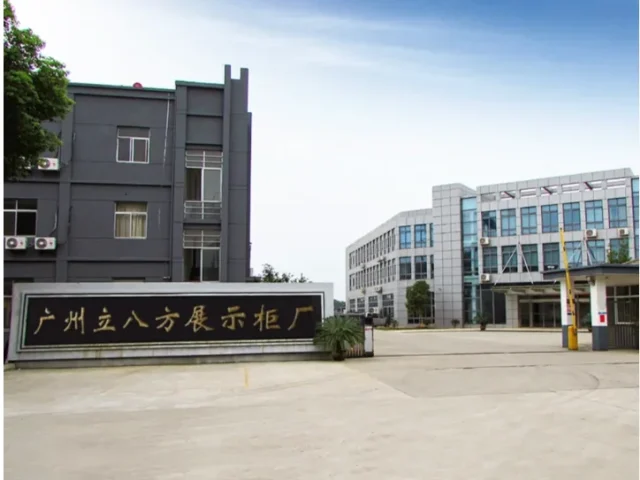
Libafang Showcase Co., Ltd. builds custom pendant display showcases in Guangzhou for jewellery stores, watch boutiques, museums and luxury retail, exporting to more than 30 countries. Each project starts with the buyer’s true stock dimensions and density target, so the board geometry, spacing and lighting are resolved before a single drawing is issued — and sample boards can be produced for approval before production.
Ready to specify your own pendant showcases? Send us your pendant lengths, piece counts and floor dimensions, and our design team will return a free layout concept and quotation, typically within two to three working days.