Historic weapons are among the most demanding objects a museum can put on display. A 19th-century sabre may weigh under 1 kg yet be 90 cm long and almost perfectly balanced on a narrow point; a matchlock musket can exceed 1.4 m and 5 kg, with a fragile wooden stock, iron barrel and original leather sling that all react differently to humidity. Add the fact that visitors expect to see edges, engraving and maker’s marks at close range, and the display case becomes an engineering problem as much as an aesthetic one. This guide covers the practical coordination between mounting, access and security when specifying museum weapon display cases, with numbers you can use in a brief.
Start With the Object Survey, Not the Case
Before any vitrine is drawn, measure and weigh every weapon and record its condition. Practical benchmarks: record overall length to the nearest 5 mm, weight to 10 g, and centre of gravity by balancing the object on a padded fulcrum. Note any loose inlays, cracked grips, active corrosion or previous repairs. A sword with a loose ferrule needs a support that carries load at the pommel and scabbard throat, not at the guard. For grouped displays, plan 80–120 mm clear space between adjacent objects so a gloved hand can pass during installation without contact.
Use this survey to set three numbers that drive the whole case design: total display load, the maximum single-object weight, and the vertical clearance needed for the tallest piece plus 60 mm of headroom for mount hardware.
Mounting Methods for Swords, Muskets and Armour
The safest mount is one that is invisible from the viewing side and fully reversible. Avoid adhesive directly on historic surfaces; instead use shaped cradles lined with conservation-grade felt or polyethylene foam (Plastazote) of 30–50 mm thickness. For long arms, two or three support points distribute load and prevent the stock from bowing.
- Vertical blade display: a machined acrylic or brass saddle at the ricasso plus a hidden tie at the pommel; the blade should never rest on its edge.
- Horizontal musket display: cradles at the fore-end, the wrist and the butt, each contoured to the object profile; expect 3–5 kg spread across three points.
- Armour and helmets: internal forms shaped to the object, with the load taken on the strongest structure rather than on rivets or lames.
- Scabbards and accoutrements: displayed separately or supported on their own cradles — never hung from a belt loop.
Make every mount removable from the front with two hands and no tools, and keep a spare set of cradle liners in storage. Specify that mounting hardware be non-magnetic near engraved steel to avoid confusion during condition checks.
Access Strategy: How the Case Opens Matters
Most damage to weapons happens during handling, so the access design deserves as much attention as the glass. For a 2 m run of wall cases, a hinged front door with a 100–110° opening and gas struts is usually easier for a single curator than sliding panels, which need clear floor space and careful sequencing. Sliding doors suit island cases where two staff can work from opposite sides.
Plan the handling path: from the store door to the case, allow a minimum 900 mm clear aisle, and provide a padded trolley at case height (typically 900–1000 mm). Specify lock cylinders that accept a single master key across the gallery, with a documented key register. If a case holds objects above 8 kg, require two-person installation and a temporary shelf or transfer board that hooks onto the case frame.
Security and Environmental Coordination
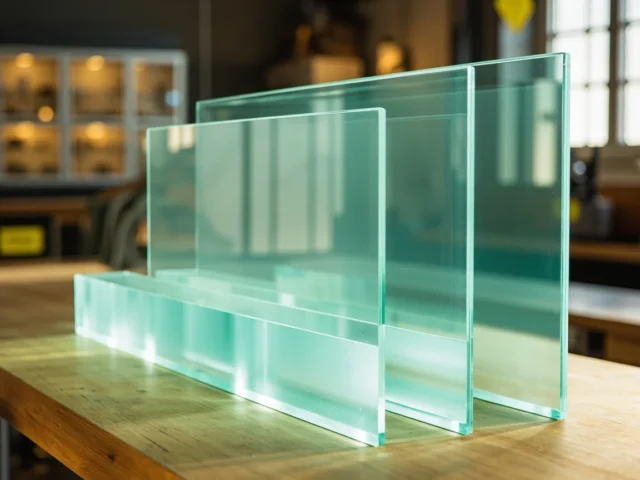
Security specification should follow the collection risk assessment. For high-value edged weapons, use 8–10 mm laminated glass or polycarbonate laminate in the door and 6 mm minimum in fixed panels, with concealed hinges and tamper-resistant locks rated to a recognised standard. Door alarms, vibration sensors and case-level contact switches should be wired during manufacture, not retrofitted, and tested before the case leaves the factory.
Climate control is equally practical: historic steel is happiest at 40–50% relative humidity with less than ±5% fluctuation per day, and stable temperature around 18–21°C. Specify silica gel cassettes or an active microclimate unit sized to the case volume (allow roughly 1 kg of conditioned silica per cubic metre of case volume for passive buffering), plus a data logger port and a calibration certificate. LED lighting at 50 lux on the object surface, with UV below 75 µW/lumen, keeps engraving legible without driving display-case heat load.
Libafang builds museum-grade vitrines in Guangzhou with these interfaces designed in from the start — mount fixing points, lock positions, sensor conduits and climate ports are agreed in the drawing set, so security and conservation teams sign off before production.
Factory Checks and Handover
Insist on a factory acceptance test covering door alignment, lock function, glass edges, mount fit (using a handling dummy of the same dimensions and weight), and climate unit operation. Record it on video. On site, commission the case empty, let it stabilise for 48 hours, then install objects and log humidity for a week before the public opening. Train at least two staff on each case type and keep a written handling procedure inside the case documentation folder.
Request a free design and quote from Libafang with your object survey, floor plan and security requirements — we will return a dimensioned case drawing, mount concept and itemised specification for review.