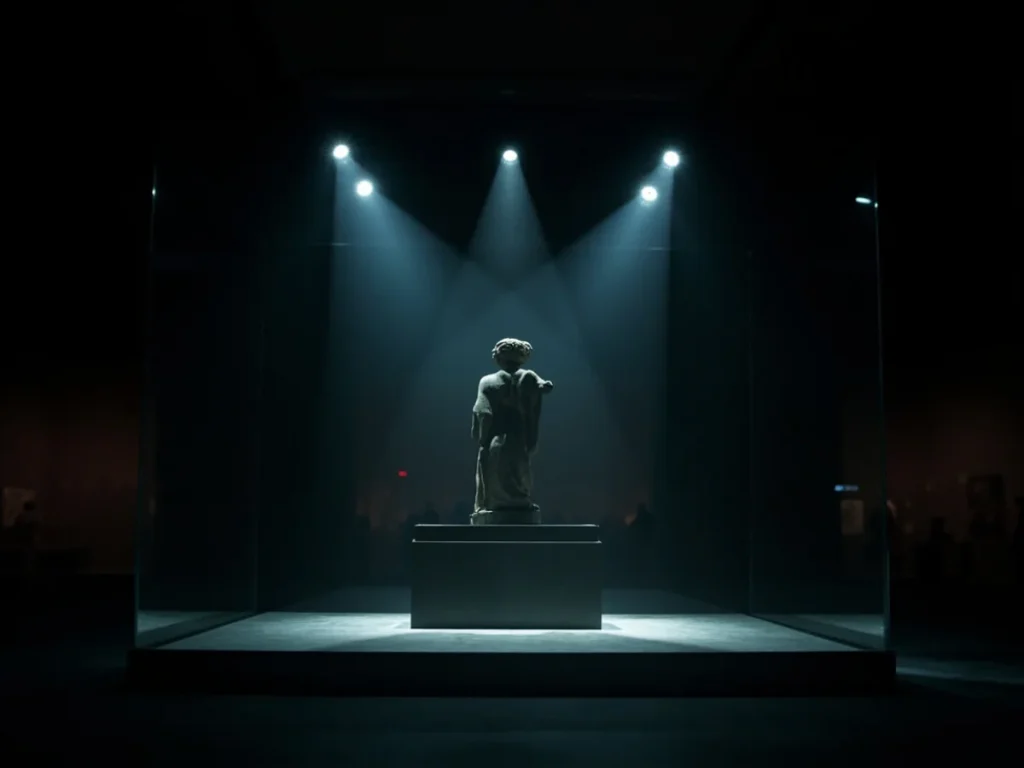
Most buyers who contact us have never set foot in a Guangzhou showcase factory. They know the city as a sourcing hub, and they have probably seen photos or videos online, but the actual working process stays invisible. That gap matters, because display showcases are not simple boxes. A single jewelry counter can involve tempered glass, brushed stainless steel, LED strips, locking systems, felt inserts and precise mitre joints, all assembled to tolerances of around 1–2 mm. If you are planning a factory visit, or deciding whether one is worth your time, here is what you will realistically see on a typical tour day at a facility in Guangzhou.
Arrival and the Showroom Floor
Visits usually start in the showroom rather than the workshop. This is deliberate. You need to see finished pieces at eye level before you evaluate how they were made. Expect a display area of roughly 200–500 square meters holding sample units: glass-top jewelry counters, wall-mounted watch display cases, museum-style vitrines, retail towers and freestanding island units. Take your time here. Open the drawers, check the soft-close hinges, look at the LED colour temperature under the glass at a 45-degree angle, and feel the edge finishing on metal frames. A useful benchmark: good showcases should show no visible glue lines, even gaps along mitred corners, and LEDs that read around 3000K–4000K for warm retail interiors or 6000K for cool museum lighting. In the showroom you can also compare materials side by side, which is far more reliable than judging from a catalogue.
Design and Engineering: From Sketch to CAD
The next stop is normally the design office, where you will see how your brief becomes a manufacturable drawing. Designers work in AutoCAD or SolidWorks (or similar 3D tools) and produce shop drawings that specify glass thickness (commonly 6 mm, 8 mm or 10 mm tempered glass), metal gauge, welding points, cable routing and hardware positions. A standard custom jewelry counter may require 3–8 drawing revisions before sign-off. If your project is complex, this is where you will also discuss structural issues: weight distribution on a glass-topped island unit, where the locking mechanism sits, and how a wall case will be fixed to a stud wall or a freestanding partition. Ask to see the revision history. It tells you how carefully the team documents changes and how disputes would be resolved later.
Material Selection and the Sample Room
A working sample room is one of the most practical parts of a Guangzhou showcase factory tour. You should be able to compare finishes directly, including:
- Metal finishes such as brushed stainless steel, mirror-polished steel, matte black powder coating, titanium gold and antique brass plating.
- Glass types including clear tempered, ultra-clear low-iron, frosted, tinted and laminated safety glass.
- Interior materials such as suede, PU leather, velvet, felt, EVA inserts, MDF, plywood and acrylic.
- Lighting components such as LED strips, spot modules, dimmable drivers and remote or touch controls.
- Hardware including key locks, cam locks, soft-close slides, magnetic catches and aluminium profiles.
Ask what is in stock and what requires a special order. Lead times for imported hardware or specialty glass usually run longer, and that directly affects your project schedule. A well-organised factory will be able to tell you which items are standard and which need 15–30 days of additional sourcing.
Production Floor: Cutting, Welding, Polishing and Assembly
The workshop is where the real process is visible. Typical stations you will pass include metal cutting and bending, welding and frame assembly, grinding and polishing, surface treatment or powder coating, glass cutting and edge processing, electrical routing for LED systems, and final assembly. Production environments vary. Some work areas are noisy and dusty by nature; that is normal. What you should watch for instead is organisation: are tools stored in fixed positions, are semi-finished frames labelled with job numbers, is there separation between metalworking and clean assembly zones, and is glass stored vertically on proper racks rather than leaning against walls. In quality-focused factories you will also see in-process checks rather than only final inspection. Ask how many units are produced per day and how many staff work on a single line. Line sizes of 10–30 workers are common for custom display showcase production, with output heavily dependent on design complexity rather than sheer volume.
Quality Control and Testing
A dedicated QC area usually sits between assembly and packing. Here you will see inspectors checking dimensions against drawings, opening and closing every drawer and door, testing locks and keys, verifying LED function and wiring, checking for scratches on polished surfaces and glass, and confirming that interior inserts fit properly. Random sampling or 100 percent inspection both exist in this industry, and you should confirm which standard applies to your order. For export projects, additional checks often include a drop test on the packed carton or a stability check on assembled units. If your destination market has specific requirements such as voltage ratings, safety glass certification or restricted substances, this is the moment to verify that documentation is prepared before shipping.
Packing and Export Preparation
The last stage you will see is packing. Display showcases are fragile, heavy and expensive to replace, so packing standards matter. Expect custom wooden crates or reinforced cartons, foam and corner protection, protective film on metal and glass, desiccant where humidity is a risk, and clear labelling with carton numbers, dimensions and weights. A single large jewelry counter can weigh 80–200 kg when crated, which is why shipping is usually arranged by sea freight with consolidation. Ask how many cubic meters your order will occupy and confirm whether the factory handles FOB, CIF or door-to-door delivery.
Seeing the process in person makes decisions much faster: you can approve finishes, resolve engineering questions and understand lead times in one visit. Libafang Showcase has been producing custom display showcases in Guangzhou for jewelry stores, watch boutiques, museums and luxury retail projects, and we welcome buyer visits by appointment. If you cannot travel, we still make the process transparent through drawings, samples and production photos. Send us your floor plan, product dimensions and brand direction, and request a free design and quote with a clear lead time and shipping estimate.