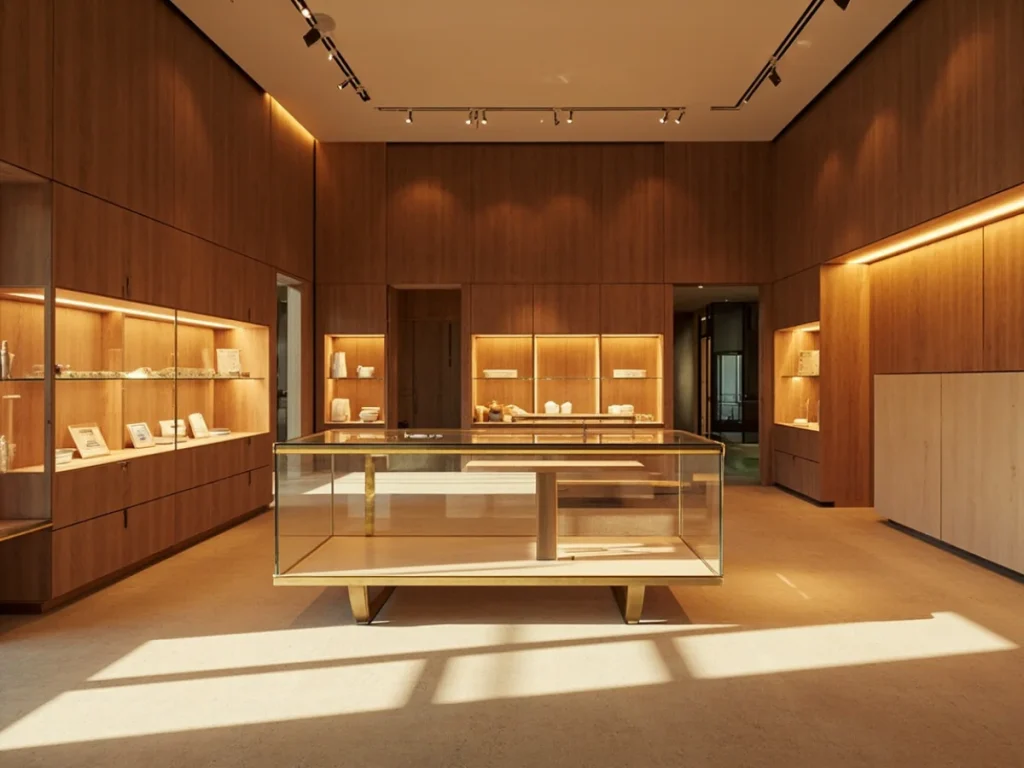
Getting jewelry display counter dimensions right is one of the highest-leverage decisions in a store fit-out. Specify too tall and customers look up at the merchandise; specify too deep and your staff stretch across glass all day. Specify too low and your neck and back suffer. The right dimensions come from three numbers — display surface height, case depth, and staff reach — and they change with what you sell and where the counter sits in the store.
Standard Height Ranges for Jewelry Display Counters
Display height should position the jewelry at roughly waist to lower-chest level for a standing customer. For most adult shoppers, that means a counter surface between 900 mm and 1050 mm from the floor. A 1000 mm surface is a safe default for standing-height display cases; it lets most customers look down at studs, rings and watches without stooping, and it keeps the merchandise below the casual arm’s-length grab zone.
When seating is provided — bridal salons, watch consultations, private viewing areas — lower the surface to 720–760 mm. That matches common chair seat heights (about 450 mm) and lets seated customers rest forearms on the counter. Museum-style vitrines usually sit somewhere between: 850 mm for seated viewing, 1000–1100 mm for standing viewing. If you have a tall counter, say 1100 mm, treat it as a back wall unit rather than the primary transaction surface.
Depth: Balancing Visibility, Storage and Security
Depth affects three things: how much product you can show, how far staff and customers lean, and how much locked storage sits underneath. Typical jewelry counter depths run 450 mm to 600 mm. At 450 mm you have a slim illuminated vitrine for watches or a single ring tray line. At 550–600 mm you get two tray rows, better lighting gradients, and room for a lockable drawer beneath.
Deeper than 600 mm, visibility and reach both suffer. A 700 mm case might look impressive, but the back third becomes a blind spot for the customer — and harder for staff to reach quickly. If you need a deep footprint, keep the glass display area at 550 mm and use the extra depth for concealed storage or a lower transaction shelf.
Height-to-depth ratio also matters. A 450 mm deep case tends to look best at 950–1000 mm high. A 600 mm deep case can carry a taller backstop, up to 1100 mm, without feeling heavy.
Staff Reach and Ergonomics: The Numbers That Matter
The people who are in this counter eight hours a day keep noticing dimensions long after the opening party. Reach is usually the first problem. Design around a comfortable forward reach of 600 mm from the staff side. Anything beyond that turns into a lean, and a lean repeated forty times a day becomes fatigue.
When specifying counter depth, plan three zones:
- Front edge to display centre (0–300 mm): the prime area for customer-facing trays and the jewellery the customer should see first.
- Mid zone (300–450 mm): secondary product, lighting control and mirror placement — still within easy reach.
- Back zone (450–600 mm): transaction surface, countertop register or bagging area on the staff side, mount for price tags — reserved for anything that doesn’t need daily handling.
If your store is wheelchair-accessible or your staff include shorter team members, plan reach at 450–500 mm and consider an adjustable or low-profile counter for greeting. Standing counters also benefit from a staff-side recess of at least 100 mm — a kneed space — so someone can stand closer to the glass without hitting the base.
Matching Counter Proportions to Product Type
Different jewelry categories have different viewing angles and merchandise sizes. Fine jewellery rings and earrings sit best in shallow cases with high-contrast fabric liners and a surface close to 950 mm. Watches need a bit more visual air — 1000–1050 mm height and 500–600 mm depth — and often an angled display block that adds 100–150 mm to the visual height without raising the counter itself. High-end bridal and diamond lines often use two heights in one shop: a 1000 mm wall of display speed-dating cases plus a 750 mm consultation desk where the customer can sit and try pieces on.
If you plan a wrap-around sales island, keep the outside face at 1000–1050 mm and the staff worktop inside at 900 mm. That gives staff a counter to write on without reaching over a high wall of glass.
Lighting Ceiling and Counter Guidelines
Lighting sits between counter height and the shopper’s eyes, so it deserves a mention in any dimension discussion. An overhead light source 1800–2100 mm from the floor, angled to the counter surface, produces the sparkle customers associate with a premium jewellery retail environment. For low counters below 800 mm, switch to low-level LEDs built into the case body rather than overhead spots, and allow 600–800 mm of vertical clearance above the highest tray to avoid glare. Keep the light source roughly 300–500 mm behind the front glass line, or the reflected glare will hide the stones.
How to Lock In Your Specifications
Before signing off on a layout, run these checks:
- Measure the destination floor: typical ceiling height is 2700–3200 mm, but a solid counter of 1000 mm plus merchandise and a spot ceiling of 2100 mm leaves workable air.
- Calculate the transaction corridor width. Aim for at least 1200 mm between the counter front and a wall or next fixture so two people can pass and a wheelchair can turn.
- Check sightlines from the entrance: the top of the counter should be visible and the display trays visible before the customer reaches the aisle end.
- Check grab-and-go security: nothing valuable should sit within the first 600 mm of a public-side counter edge without staff presence.
- Confirm a top margin for cleaning: 50–100 mm above the highest display item lets staff dust and restock without disassembling the case.
Libafang Showcase Co., Ltd. builds custom counters to these dimensions for jewellers, watch boutiques, museums and luxury retailers across more than 30 countries. If you want to measure once and get it right, send us your store plan or a sketch — we will return a dimensioned proposal, a free 3D render, and a quote within five working days. Request your free design and quote and we will help you set every millimetre with confidence.