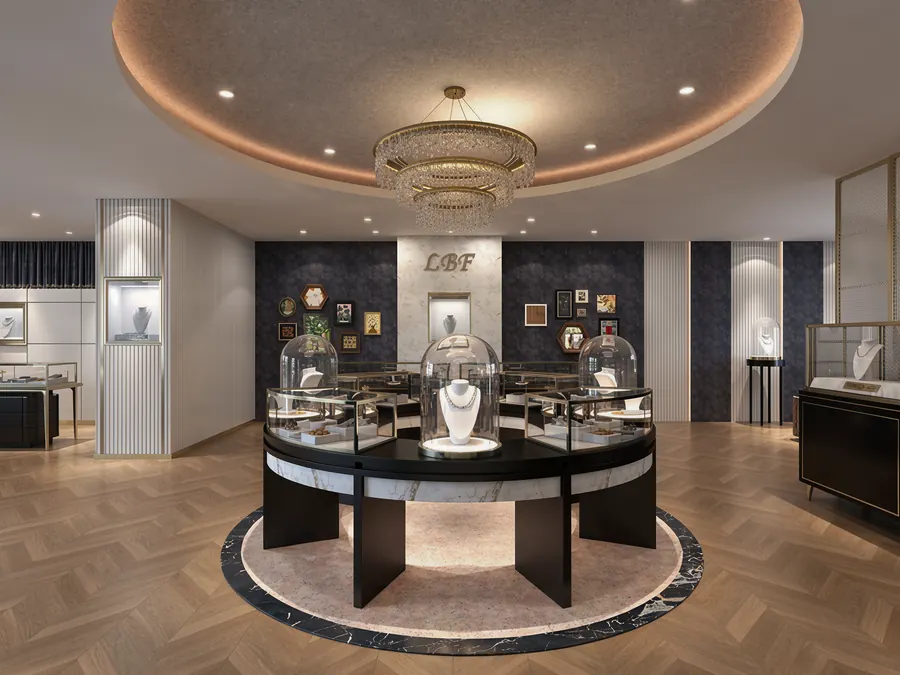
Choosing between freestanding and wall-mounted jewelry display cases is one of the first decisions that shapes a store’s layout, budget and security plan. Get it right and your floor plan flows, high-value pieces sit at eye level, and staff can watch the room from anywhere. Get it wrong and you end up with blocked sightlines, cramped aisles, or glass cases that never quite fit your best-selling categories. This guide breaks down both jewelry display case types with concrete dimensions, costs and product fit, so you can specify the right mix before you place a manufacturing order.
What Counts as Freestanding and Wall-Mounted
Freestanding jewelry display cases stand on the floor on their own base, typically 900–1100 mm tall for counter-height units and 1200–1400 mm for tower or pedestal styles. Standard footprints run 600 × 600 mm up to 1200 × 600 mm. They can be placed in the middle of a sales floor, used as island units, or pushed against a wall without attachment.
Wall-mounted jewelry display cases fix to a wall or recessed niche, usually with the glass body starting 800–1000 mm above the floor so customers see the top shelf comfortably and staff can clean beneath. Depth is often 250–400 mm — deep enough for ring trays, bracelets and small watches, but not for large necklace busts or full watch winder cabinets.
Between these two poles sit semi-freestanding counters, corner vitrines and modular wall systems. Most stores need a combination rather than one type alone.
Floor Space, Traffic Flow and Store Size
Footprint is where the two types diverge fastest. In a 100 m² boutique, freestanding cases at 1000 × 600 mm plus a 900 mm walking aisle on each side consume roughly 2.5 m² each once you count clearance. Ten of them eat 25 m² — a quarter of the store — but they also create natural browsing loops and impulse stops.
Wall-mounted cases use the perimeter instead. A 10 m wall of 1000 mm-wide units gives ten display positions in a strip about 400 mm deep, or roughly 4 m² of usable floor. For narrow stores under 60 m², that difference decides whether you can fit a checkout counter and a consultation seat at all.
Rule of thumb: use wall-mounted units for density and freestanding units for focal impact. A common split for a 80–120 m² jewelry store is 60% wall-mounted linear display and 40% freestanding islands or counters.
Security, Staffing and Insurance
Security requirements push the decision as much as design. Freestanding cases placed in open floor areas require clear lines of sight from the till and door. If staff cannot see all six sides, either move the case or add mirrored or camera coverage.
Wall-mounted cases are easier to supervise in a linear store because they sit in one visual band behind the counter. They also make cable routing simpler for alarms and CCTV. Freestanding cases typically need floor boxes or discreet under-base channels for power and alarm wiring, which affects installation cost and whether you can reposition them later.
For high-value items — loose diamonds, gold chains above 50 g, premium watches — many insurers expect lockable, screwed-down units or cases that can be tethered. A wall-mounted case is inherently harder to remove; a freestanding case may need a bolted base or hidden floor anchor. Ask your insurer before finalizing the layout, not after.
Which Product Range Fits Which Case Type
Case proportions should follow the products, not the other way around. Use this breakdown when mapping your range:
- Rings and earrings: wall-mounted cases with 250–300 mm depth and sloped or tiered trays. Small items read well at 1200–1500 mm viewing height and need limited depth.
- Bracelets and bangles: freestanding counters at 950–1050 mm with 400–500 mm depth for horizontal displays, or wall-mounted units with pull-out trays.
- Necklaces and pendants: freestanding tower or island cases with 500–600 mm depth to fit busts and longer drop height; wall-mounted units usually cannot show full length convincingly.
- Watches: freestanding islands with lockable drawers and winder space, or deep wall-mounted cases with at least 350 mm depth if winders are mounted upright.
- High-ticket statement pieces: single-item freestanding pedestals with 360° viewing, ideally at 1100–1200 mm height for standing customers.
If your range is mostly small, high-volume SKUs, wall-mounted cases will show more pieces per square meter. If you sell statement necklaces, heritage watches or custom commissions, freestanding cases give the object the space and drama it needs.
Lighting, Power and Climate
Both types can be lit to a high standard, but the engineering differs. Wall-mounted cases often hide LED strips and drivers in the wall cavity, keeping the glass body visually clean. Freestanding cases need internal or under-shelf LED modules with heat management, especially if you display watches or cosmetics that are sensitive to temperature.
Typical figures worth specifying: 3500–4000 K color temperature for warm retail tones, CRI above 90 so stone color reads accurately, and 800–1200 lux at the display surface for jewelry. For watches and high-value pieces, consider 12 V DC low-voltage LED and a lockable cable entry point so power and alarm wiring share one protected route.
Museum and heritage clients often add humidity control or desiccant compartments. That is easier to integrate into a freestanding case with a service base than into a shallow wall niche.
Cost, Lead Time and Customization
At the manufacturing stage, a standard freestanding glass jewelry case often costs more than a wall-mounted unit of similar width because of the base, structural frame and internal wiring. Freestanding units also ship as larger, heavier cartons, which raises freight per unit for export orders.
Wall-mounted cases can be more economical per display position, but they require accurate wall measurement and on-site fixing, which shifts labor to installation. For projects with irregular walls or heritage interiors, recessed wall-mounted cases may need bespoke fitting and longer lead time.
Freestanding cases win on flexibility: you can redesign the floor plan, rotate seasonal displays and reuse the same unit across locations. Wall-mounted cases win on stability, clean sightlines and space efficiency. Most successful stores end up with both, matching the case type to the product and the traffic path.
Whichever route you take, lock the plan to your product dimensions first — case depth, tray pitch, viewing height and lighting angle — then confirm security and power. Libafang manufactures both freestanding and wall-mounted jewelry display cases, so we can build a single mixed specification or a modular system that grows with your range.
Send us your product list, store plan or rough dimensions and we will return a free design proposal and quote, including case sizes, lighting layout and export packing. Tell us your product range and target market, and we will recommend the case types that earn their space.