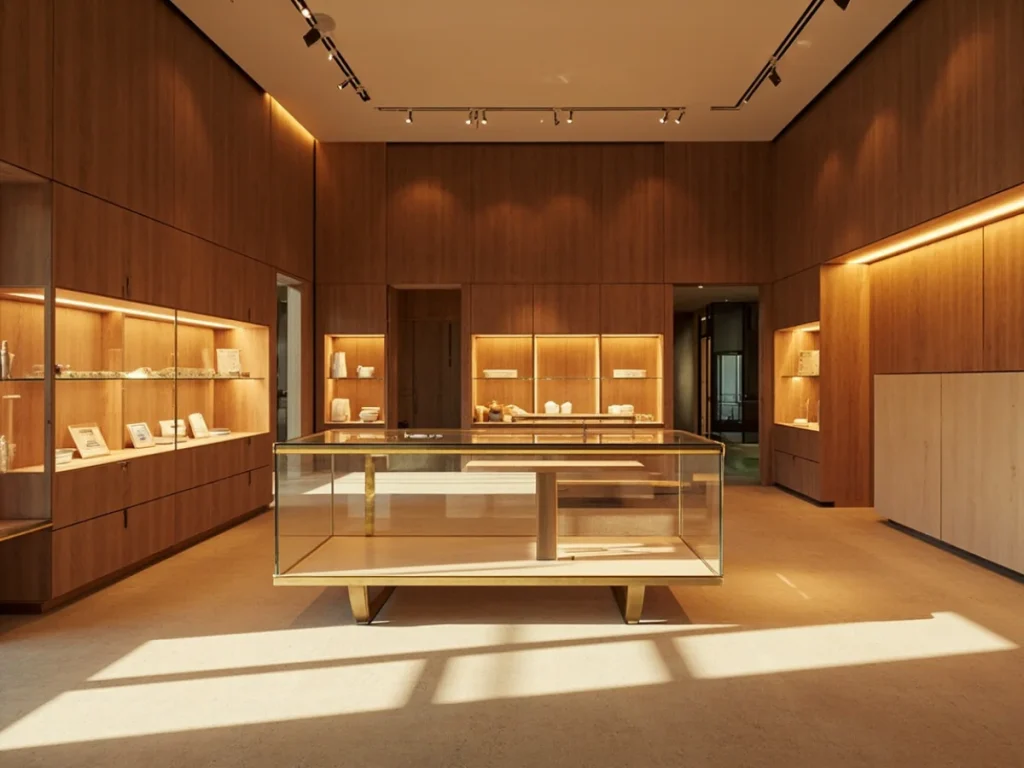
Selecting the right museum display case types is a decision that directly affects object safety, visitor engagement, and gallery workflow. Two of the most common formats—wall-mounted cases and freestanding vitrines—serve different purposes, and choosing between them requires a clear-eyed look at what you are displaying and how people will view it. This article breaks down the decision using object size thresholds, viewing access requirements, and practical specifications, so you can match the case type to the collection rather than the other way around.
Wall Cases: Best for Small to Medium Objects with Controlled Access
Wall cases are typically mounted at 900–1200 mm (35–47 in) above finished floor, with interior depths ranging from 150 mm to 400 mm (6–16 in). They excel at displaying flat or shallow objects: jewelry, watches, medals, documents, small ceramics, and delicate artifacts that benefit from being viewed at close range. Because the case is off the floor, it frees up gallery space and reduces the risk of accidental knocks from visitors or cleaning equipment. However, wall cases impose a hard size limit. Anything deeper than about 400 mm or taller than 600 mm will feel cramped and may be difficult to light evenly. Wall cases are ideal when object depth is under 300 mm and weight is under 15 kg per shelf. They also require secure wall backing—concrete or steel studs—to support the case and its contents, which can be a constraint in historic buildings.
Freestanding Vitrines: Built for Larger, Heavier, and 360-Degree Viewing
Freestanding museum vitrines are floor-standing cases that allow visitors to walk around all four sides. Standard footprints range from 600 × 600 mm to 1200 × 1200 mm, with heights from 1000 mm to 2200 mm. They are the go-to choice for sculptures, large ceramics, costumes on mannequins, taxidermy, and any object that needs to be seen in the round. Choose a freestanding vitrine when object height exceeds 600 mm or when 360-degree viewing is essential. These cases also accommodate heavier objects—load capacities of 100–300 kg are common—and can be fitted with internal lighting, climate control, and secure locking mechanisms. The trade-off is floor space: a typical freestanding vitrine occupies 1–2 square meters, and you need at least 900 mm of clear circulation space around it to meet accessibility standards.
Key Decision Factors: A Side-by-Side Comparison
To simplify the choice, evaluate your display needs against these criteria:
- Object size: Wall cases suit items under 400 mm deep and 600 mm tall; freestanding vitrines handle items up to 2000 mm tall and 1000 mm deep.
- Viewing access: Wall cases offer frontal viewing only; freestanding vitrines provide 360-degree access.
- Security: Both can be locked, but freestanding vitrines often require anchored bases or floor weights to prevent tipping.
- Installation: Wall cases need structural wall support; freestanding vitrines need level flooring and clearance for doors.
- Lighting: Wall cases are easier to light from above; freestanding vitrines may need internal LED strips to avoid glare from all sides.
- Cost: Wall cases typically cost 20–30% less per linear meter due to simpler construction and fewer glass panels.
Viewing Access and Visitor Flow
Viewing access is not just about sightlines—it is about how visitors move through the gallery. Wall cases concentrate traffic along walls, which can create bottlenecks in narrow spaces. Freestanding vitrines act as islands, encouraging a more dispersed flow but requiring wider aisles. For high-traffic museums, a mix of both types often works best: wall cases for dense, small-object displays and freestanding vitrines for hero pieces that deserve a 360-degree view. Consider also the height of the intended audience. For children or wheelchair users, wall cases should have their lowest shelf no higher than 900 mm, while freestanding vitrines should offer a clear line of sight from 800 mm to 1600 mm.
Material and Environmental Considerations
Both case types can be built to conservation-grade standards, but their environmental control differs. Wall cases have less internal volume, so they reach stable humidity faster and use less silica gel—typically 1–2 kg per cubic meter of case volume. Freestanding vitrines, with larger volumes, may need 3–5 kg of silica gel and more robust sealing to maintain 50% ±5% RH. If you are displaying sensitive materials, such as parchment or textiles, the smaller volume of a wall case can be an advantage. For heavy or awkward objects, freestanding vitrines with removable front panels or hinged doors simplify installation and cleaning. Libafang manufactures both types with options for anti-reflective glass, UV filtering, and hidden ventilation, allowing you to tailor the case to the object’s needs.
Making the Final Choice
Start by measuring your objects: depth, height, weight, and the number of viewing angles required. If the object is shallow and front-viewed, a wall case saves space and budget. If it is deep, tall, or needs to be seen from all sides, a freestanding vitrine is the safer bet. Also consider future flexibility—freestanding vitrines can be repositioned as exhibitions change, while wall cases are more permanent. For a balanced gallery, plan for 60–70% wall cases and 30–40% freestanding vitrines, adjusting based on your collection’s profile. Whichever route you take, ensure the case meets your security, climate, and accessibility requirements before finalizing the design.
Ready to specify the right museum display case types for your collection? Libafang offers free design consultation and quoting for custom wall cases and freestanding vitrines, with export-ready production for clients in 30+ countries. Share your object dimensions and viewing requirements, and we will recommend the most efficient case configuration for your space.