Mirrors are the most under-planned element in a luxury boutique fit-out. Retailers choose a frame and a wall, then discover that the reflection doubles a light source, reveals a stockroom door, or throws a glare across a diamond case at eye level. For anyone specifying luxury boutique display mirrors, the working rule is simple: a mirror should be positioned relative to the products it serves, not relative to the empty wall it occupies. This guide covers the placement logic — angles, heights, distances and lighting coordination — that keeps mirrors reinforcing your showcases rather than fighting them.
Start from the display plan, not the wall
Draw the showcase layout first. Mark every sightline a customer can hold while standing at a counter, seated at a consultation table, or walking the perimeter. A mirror earns its place only if it appears inside one of those sightlines at a useful moment. In practice, that means three working positions: beside a showcase, behind the customer, or above and behind the sales associate.
A mirror beside a case sends the product’s profile back to the viewer — valuable for earrings, bracelets and watch cases where the side elevation matters as much as the front. A mirror behind the customer gives a natural try-on view without asking staff to hold a hand mirror. A mirror behind the associate shows the customer what the associate sees while presenting a piece, which is why it works well in watch boutiques with seated consultation desks.
Angles and heights that actually work
Full-length mirrors in fitting areas should tilt 2–5 degrees from vertical toward the viewer; this is enough to bring the head and feet into a single glance without the distorting elongation that starts around 8–10 degrees. For vanity-height mirrors at jewelry counters, a 5–7 degree tilt suits a customer standing 600–800 mm away.
Mount height is where most fit-outs go wrong. Set the mirror’s centre at roughly 1,500–1,600 mm from finished floor for standing customers of average height, and 1,200–1,300 mm for seated consultation. If your clientele skews taller or shorter, or the store serves a wide range, favour the lower figure — customers crouch more readily than they stretch.
- Full-length mirror: bottom edge 150–200 mm above floor, centre at 1,500–1,600 mm, tilt 2–5 degrees.
- Counter-side mirror: width 300–450 mm, centre at 1,350–1,450 mm, aligned with the case’s front third.
- Consultation mirror: centre at 1,200–1,300 mm, 500–700 mm from the seated customer’s shoulder.
- Accent or panel mirrors: keep the reflective surface at least 900 mm from any halogen or spotlight aimed at a case.
Keep mirrors out of the lighting path
Mirrors double every light source they face, and in a jewelry store that usually means glare. Aim for no direct line between a spotlight and a mirror surface. Where a mirror must face a lit case, use a diffused or bounced source, or angle the mirror so the reflection lands on a matte wall rather than back into the customer’s eyes.
Colour temperature should match the store’s display lighting — 3000K to 3500K is the usual range for luxury retail — so that a piece seen in the mirror reads the same as one seen in the case. A 4000K mirror wall beside a 3000K showcase creates a visible colour shift on skin and metal, which customers notice even if they cannot name it.
Also control what the mirror reflects. A polished mirror aimed at a bright backlit logo panel or an open stockroom door undercuts the calm a boutique is selling. Before ordering, photograph the intended position from the customer’s eye height and check the reflected view; it is cheaper to move a mirror 400 mm than to rebuild a wall.
Coordinate finishes with the showcases
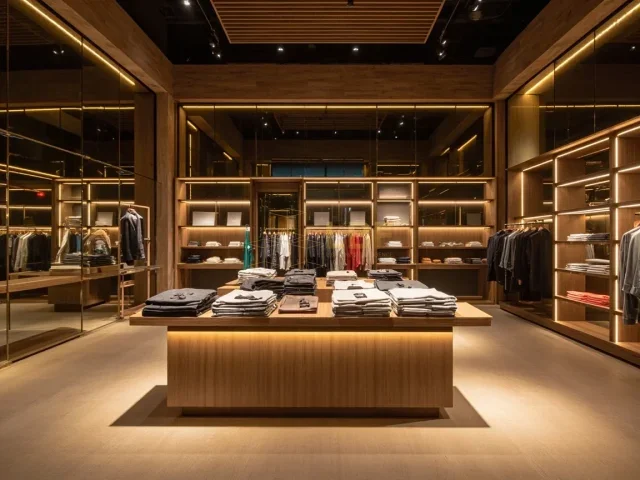
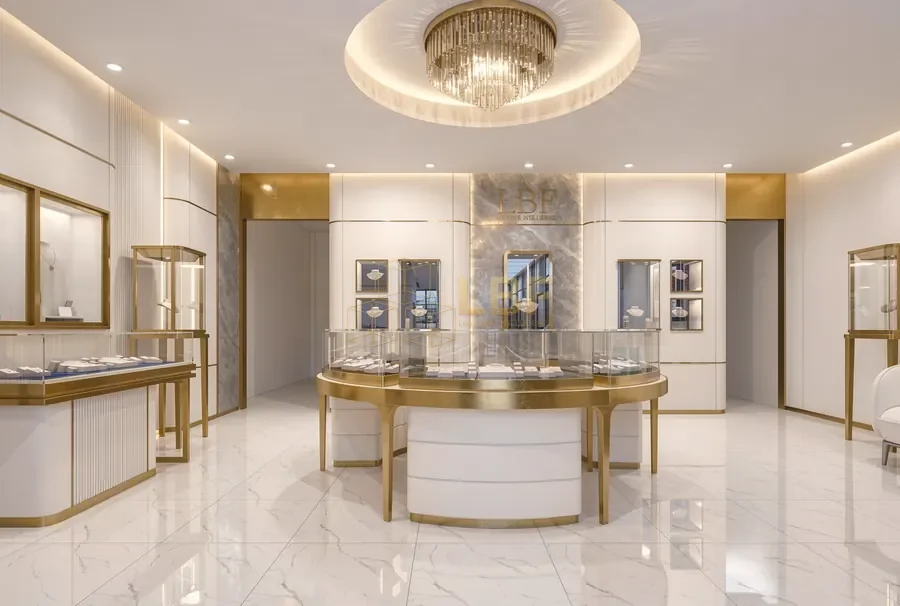
Mirrors and showcases are read together, so their finishes should be decided together. A brass-framed mirror beside a brass-trimmed jewelry case creates a deliberate pairing; the same mirror beside a black steel case looks like an afterthought. Keep to two metal finishes per zone and repeat them across cases, mirrors, signage and hardware.
Frame depth matters too. A mirror frame set 40–60 mm deeper than the adjacent showcase profile reads as intentional architecture; a flush frame beside a deep case looks thin. Where the mirror sits directly on a display wall, align its top edge with the case top or with a horizontal datum line — a shared line at 1,400 mm or 1,800 mm does more for visual order than any amount of decorative trim.
Build mirrors into the display system
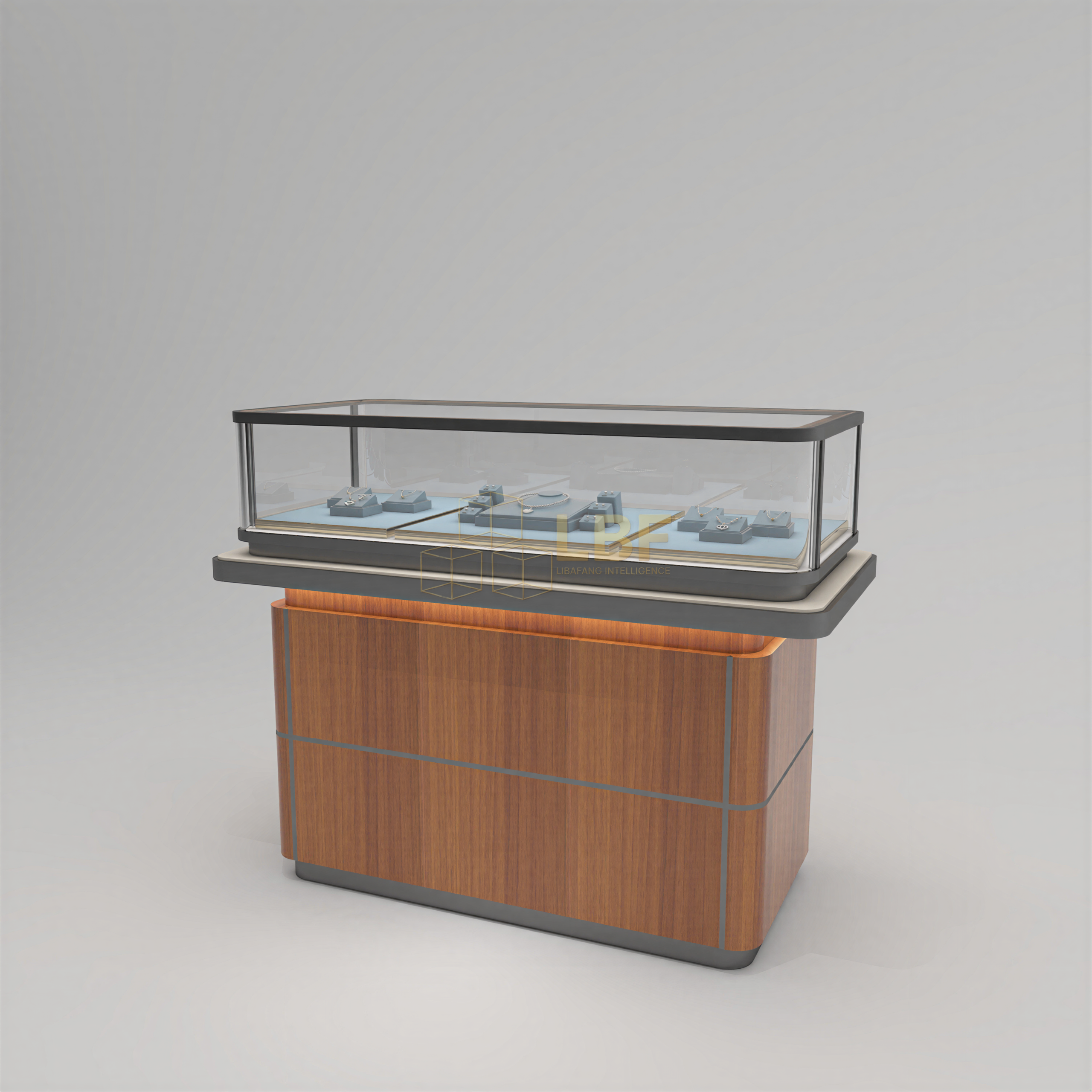
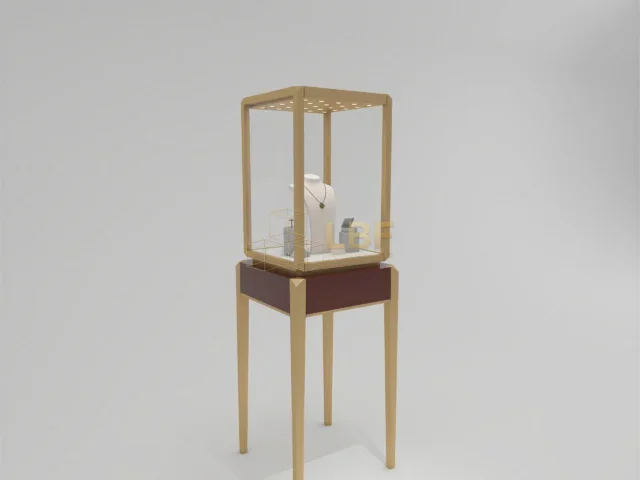
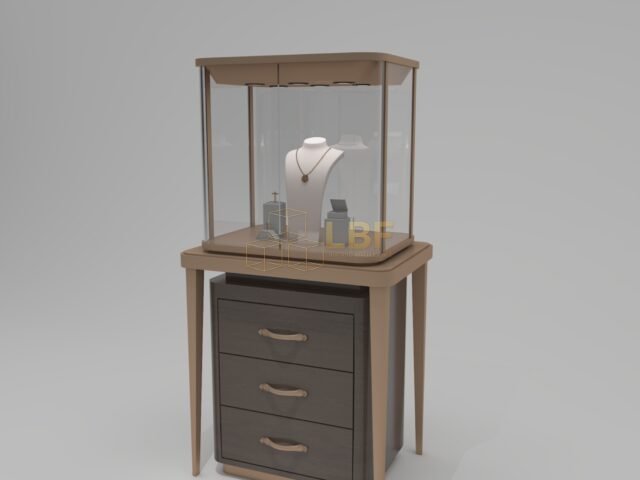
The strongest layouts treat mirrors as part of the showcase assembly rather than as wall decoration. A display unit can carry a mirror panel on its return side, so the customer sees the product’s back as they turn away — useful for pendants, watch clasps and hair accessories. Integrated panels also solve the retro-fit problem: when the mirror is designed with the case, the lighting, the sightlines and the frame finish are resolved on one drawing.
Libafang builds display showcases and mirror panels for jewelry stores, watch boutiques and museums, and we prefer to quote them together so that dimensions, finishes and lighting channels match. A practical specification is to note, for every mirror position, the wall it sits on, the showcase it serves, the viewing distance and the nearest light fitting — four lines of information that prevent most placement errors.
Common placement mistakes to check before sign-off
Review the plan against these before production: mirrors that face the entrance and catch daylight; mirrors placed behind a counter where staff stand, doubling silhouettes during consultation; acrylic or low-iron glass specified without checking the tint on white walls; and mirrors mounted without a backing gap, which traps cleaning moisture against the wall.
On materials, low-iron glass is worth the cost where product colour accuracy matters — it removes the green cast visible on standard float glass edges and in large panels. For safety and handling in busy stores, specify a safety backing film on any mirror above 900 mm in height.
Done well, mirror placement is invisible: the customer simply sees more of the piece, from more angles, in better light. Done badly, it is the first thing anyone notices. Get the plan right and the rest of the boutique reads calmer.
Send us your floor plan and showcase schedule and we will mark up suggested mirror positions, frame finishes and lighting coordination — then prepare a free design and quote for the full display package.