Coins are among the hardest objects to display well. A denarius or a silver dollar is only 18 to 40 mm across, yet it must be legible from a standing visitor’s eye height, protected from fingerprints and humidity swings, and secure enough for an insured collection. Most failures in museum coin display cases come down to three planning decisions made too late: how the trays are gridded, how the labels are sized and placed, and how far the glass sits from the visitor’s eye. Get those right before you order cases and the rest — lighting, locking, climate control — becomes straightforward engineering rather than a retrofit. This guide gives concrete starting numbers for each.
Start With the Coin, Not the Case
Before choosing a case footprint, catalogue the collection by diameter and thickness, because those two numbers drive every downstream decision. Group coins into rough bands: under 20 mm (small medieval and fractional issues), 20–30 mm (most ancient denarii, many modern minors), 30–40 mm (crown-sized silver, large bronzes), and above 40 mm (medals, presentation pieces). Then note thickness, since a 4 mm thick medal needs a deeper recess than a 1.5 mm hammered penny.
As a rule of thumb, allow a minimum 8–10 mm of clear space between the coin edge and the next coin or tray divider. Below that, reflections and shadow overlap make adjacent coins hard to read. For coins above 30 mm, increase the gap to 12–15 mm. A typical museum coin display case for a 1,000-piece collection might use 12 to 20 trays of 40–60 coins each, with the balance of the collection in drawers below the visible deck.
Tray Layouts That Actually Read Well
Tray geometry is where most designs go wrong: a beautiful grid on paper becomes a visual maze once glass, reflections and a 2.5 m viewing distance are added. Keep grids simple and consistent. Rectangular grids suit typological or chronological sequences; radial or arc layouts suit single highlight coins but should not be repeated across a whole case.
Practical specifications that work across most institutions:
- Tray size: 400 × 300 mm or 450 × 350 mm is a workable maximum for a single glazed opening; larger trays are hard to lift and increase handling risk.
- Grid pitch: 35–45 mm centre-to-centre for coins under 30 mm; 50–60 mm for larger issues. This keeps labels aligned and prevents crowding.
- Recess depth: coin thickness plus 1–2 mm clearance, with a felt or EVA insert. Do not over-deepen; a coin sitting below its recess catches shadow.
- Tilt: a 5–10° tray incline improves readability for coins displayed below eye level; keep the tilt consistent across all trays in a case.
- Handling: recessed finger pulls on every tray, and no tray wider than 500 mm if it must be lifted by one person.
Keep one coin family per tray where possible. Mixed trays force visitors to hunt, and curators to re-label during rotations.
Label Sizing and Placement
Labels fail when they are designed at desk distance and viewed at standing distance. Set type size from the reading distance, not from the label’s physical size. For a typical 1.5 m viewing distance, 9–10 pt text is the practical floor; at 2 m, use 11–12 pt; at 3 m, 14 pt or larger. Never go below 8 pt, and keep the accession number in a lighter weight or smaller size than the object name so the eye lands on the name first.
Placement should be predictable: label directly below or to the right of the coin, always on the same side across the tray. Keep the top line of the label at least 10 mm from the coin recess so the coin does not cast a shadow on the text. Use matte, low-reflectance label stock — gloss labels under glass at 45° become mirrors. If the case is lit at an angle, test a sample label with the actual light before committing to print.
For long labels, set a maximum of two lines of object name plus one line of date and origin. Anything longer belongs on a graphic panel at the case end, not beside each coin.
Calculating Viewing Distance and Case Height
The comfort zone for a standing visitor is roughly 1.2–1.8 m from the glass, with eye height around 1.55–1.65 m. Set the primary display band so the coin centres fall between 1.25 m and 1.65 m above finished floor. Below 1.0 m, visitors stoop; above 1.75 m, small coins become unreadable without stepping back, which increases the apparent distance further.
Match the coin’s apparent size to the required detail. A 20 mm coin at 1.5 m subtends a very small angle; if inscriptions must be readable, either bring the case forward, add a magnifier, or reserve small coins for the upper band of a case where visitors naturally lean in. As a sanity check, place a sample coin in a temporary mock-up at the real case position and view it from 1.5 m and 2.5 m before finalising drawings.
Glass, Lighting and Security Details
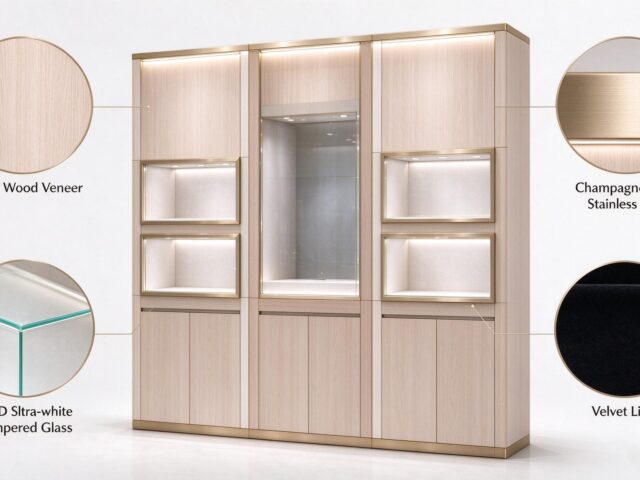
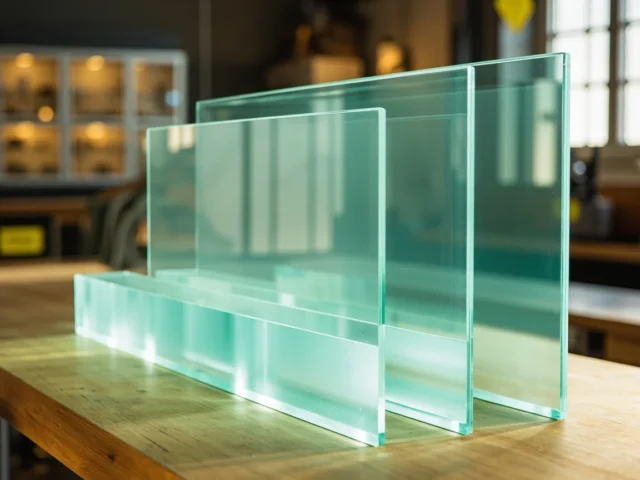
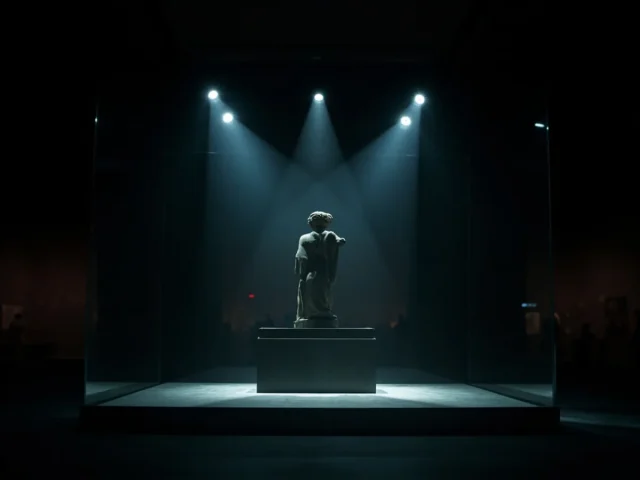
Use low-iron, laminated glass with an anti-reflective coating; coin surfaces show every reflection. LED lighting at 3000–4000 K with a CRI above 90 keeps silver looking silver rather than blue. Keep UV output negligible and fit a lockable, tamper-evident closure. For display cases produced by Libafang, trays, recessed inserts and label holders are typically made as a matched set so that grid pitch, tilt and label position stay consistent across rotations — a detail that matters when a 12-tray case is re-dressed twice a year.
Plan Around Rotation
Most coin collections rotate. Design trays so a full tray can be lifted out and replaced without disturbing neighbours, and keep spare trays in the same grid standard. A consistent 40 mm pitch across a whole suite of museum coin display cases reduces handling time and label reprinting, and it lets you swap a highlight coin into a focal position without rebuilding the insert.
If you are planning a coin gallery or upgrading an existing suite, send us your coin list, tray count and floor plan. Libafang Showcase Co., Ltd. will prepare a free design layout and quote with recommended tray grids, label sizes and viewing distances tailored to your space and collection.