Textiles are among the most difficult museum objects to display well. A silk banner, a military uniform, a tapestry fragment or a beaded ceremonial robe is soft, heavy and structurally weak at the same time. Hang a fragile textile from its top edge and gravity will strain the warp threads within weeks; lay it flat on a solid shelf and the fabric can compress, crease or shift. Museum display cases for textiles must therefore do more than enclose an object behind glass — they must support the entire textile across its full surface while keeping humidity stable, light low and visitors close enough to see every stitch.
The specification decisions that matter most are mechanical, not cosmetic. Below are the practical rules we apply when designing and building textile cases for museums, heritage houses and touring exhibitions.
Support the textile over its whole area, not just at the edges
The safest default for a fragile flat textile is horizontal display on a rigid, padded board sized to the object. A support board should extend 20–50 mm beyond the textile on every side so that no edge hangs unsupported; anything larger is wasted material and gathers dust. Cover the board with washed, undyed cotton or a smooth needle-punched felt, then bridge any applied embroidery, beadwork or metal thread with a soft padded insert so raised areas are not crushed against the surface. For very weak fabrics, a sloped board of 10–15° improves viewing without adding meaningful shear stress; slopes above 30° start transferring weight to the lower stitches and should only be used with a conservator-approved mount.
Where gravity cannot be avoided — flags, banners, hanging garments — distribute the load across a wide, continuous support such as a padded roller or a full-width Velcro-compatible band. A single row of stitches or clips along the top hem concentrates the entire weight of a 3 kg wool coat onto a few hundred threads. Never let a hanging textile carry its own weight on original stitching.
Control the microclimate inside the case
Textiles are hygroscopic: they expand and contract with relative humidity, and cycling is more damaging than a stable but slightly imperfect level. Most textile collections are happiest at 45–55% RH with no more than ±5% drift per 24 hours, and at 18–20 °C. A sealed case with a conditioned gasket and a small quantity of silica gel or a passive humidity buffer can hold that band far more reliably than a room-wide HVAC system, especially in historic buildings.
Case design drives this. Specify a low-leakage enclosure with continuous EPDM or silicone gaskets, cable glands sealed at entry, and a buffer tray accessible without opening the display volume. Include a calibrated data logger inside the case for the first 4–6 weeks; use the readings to adjust the buffer quantity rather than guessing. For loan exhibitions, build in a 24–48 hour equilibration window before the object goes on view.
Keep light exposure inside a strict budget
Light damage to textiles is cumulative and irreversible. Sensitive dyed fabrics — silk, wool, most historic costume — should be held to 50 lux with a maximum of 50,000 lux-hours per year; moderately sensitive materials can take 150–200 lux. A case cannot create that budget alone, but it can govern it: specify LED luminaires with no UV output (UV below 75 µW/lumen, ideally zero), mount them outside the display volume or in a separate light box, and fit a diffuser so no hot spot exceeds 1.5 times the average illuminance across the textile.
Add a physical light-control layer: blackout blinds, timed dimming, or a motion sensor that raises illumination only when a visitor is present. For permanent galleries, plan for rotating light-sensitive objects every 6–12 months, and design the mount so the textile can be lifted out without dismantling the case.
Design the case around the mount and the viewer
A textile case is really a furniture system for a mount. Decide early how the object will be installed, inspected and removed, then dimension the case accordingly. Useful working figures:
- Clearance: 40–80 mm between the textile surface and the inside of the glazing; more for deep relief or framed costume.
- Viewing height: centre of a flat textile at 1,300–1,500 mm from floor for standing visitors, lower for seated viewing or children’s galleries.
- Access: hinged front or removable glazing panel with a minimum 600 mm clear opening, plus gas struts rated for the panel weight.
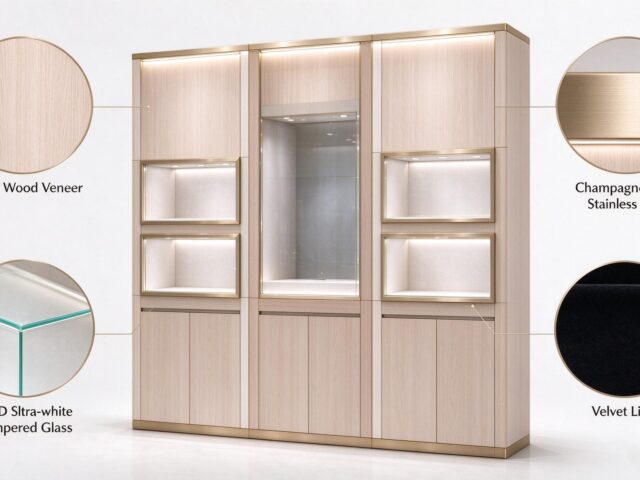
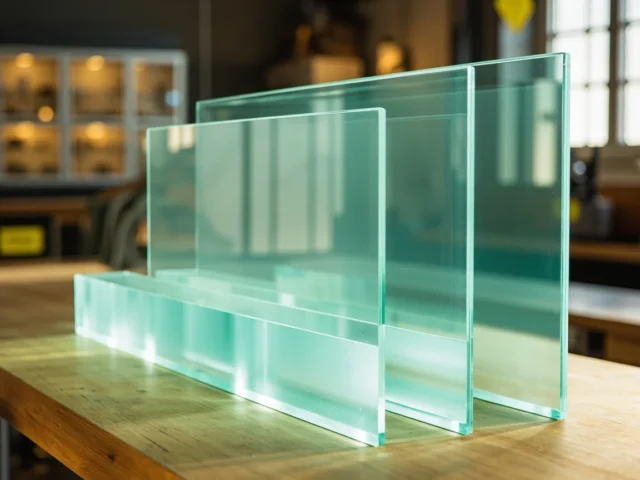
- Glazing: laminated low-iron glass with an anti-reflective coating; 6.4–8.8 mm is typical, with laminated interlayers retained for security in public galleries.
- Base: levelling feet and a sealed plinth of at least 100 mm, with ventilation slots kept out of the display volume.
Framing a textile is another common request. If the object is strong enough, a shallow shadow box with a padded mount and spacers gives good protection and excellent sightlines; for weak or beaded pieces, keep the textile horizontal and use a mirrored or angled viewing panel instead of hanging it vertically.
Choose materials that will not off-gas
Adhesives, sealants, MDF, some paints and certain foams release acetic acid, formaldehyde or sulphur compounds that attack textile fibres and metal threads. Specify low-emission, conservation-grade materials: powder-coated steel or anodised aluminium frames, water-based or solvent-free finishes fully cured before assembly, inert polyethylene or polypropylene foams, and undyed cotton, linen or washed muslin in contact with the object. Ask suppliers for material safety data and odour-cure times, and allow 2–3 weeks of ventilation before an object is installed in a newly built case.
At Libafang we build textile cases for museums and heritage sites on this basis: sealed gasket systems, conservation-grade linings, controlled LED lighting and mounts engineered around the object’s weight distribution rather than the cabinet’s symmetry. Each unit is drawn and reviewed with the curator before production, so the mount, the case and the installation sequence are resolved together.
Plan for handling, not just display
The best case fails if the object cannot be safely moved in and out. Provide a removable or sliding support board with handles or lifting points, label the correct orientation, and keep a written install sequence inside the case file. For a 1.5 m × 1 m textile, plan two trained handlers and a clear 1.2 m access aisle. Rehearse the installation once with a dummy load before the real object leaves the store.
Get these details right and a textile case becomes almost invisible: the fabric reads flat and undistorted, the colours stay true, and the object survives decades of display. Get them wrong and the damage appears slowly, long after the opening night photographs.
If you are planning a textile gallery or a single significant display, send us the object dimensions, condition notes and room conditions — we will return a free design proposal and quote with mount, case and climate recommendations within a few working days.