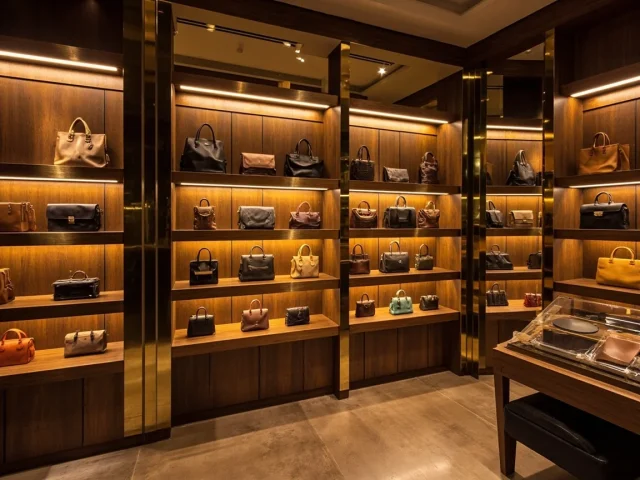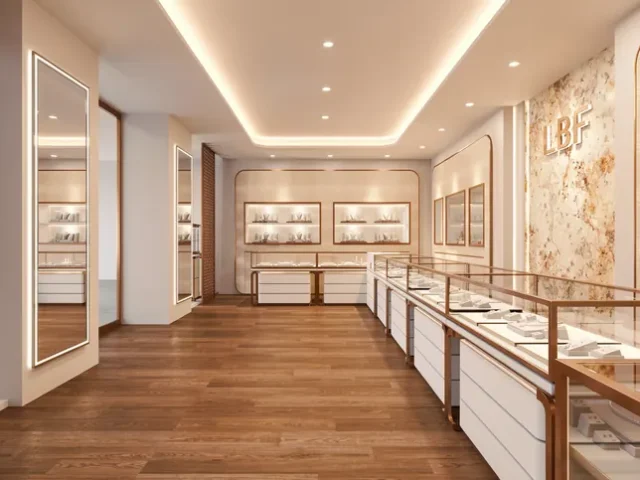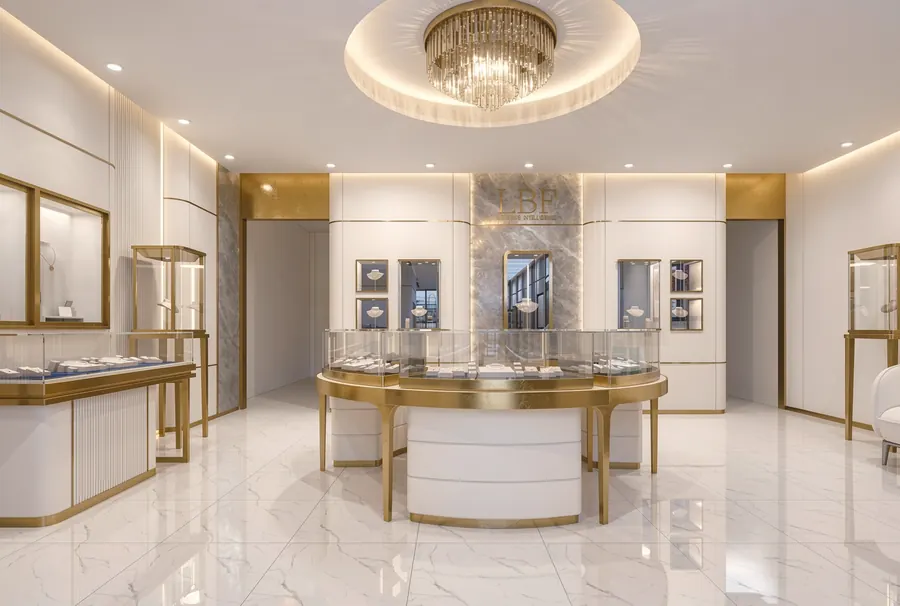
A silk or cashmere scarf is one of the hardest accessories to merchandise well. Folded flat it loses its drape; hung badly it stretches out of shape; crammed on a shelf it reads as cheap. For jewelry stores, watch boutiques and fashion retailers that stock scarves alongside higher-ticket items, the display fixture effectively sets the perceived value of the product. This guide breaks down the three main presentation systems for luxury scarf display fixtures — hanging, folding and drawer — and gives the dimensions, capacities and material specs buyers need to specify a workable unit, whether for a single counter display or a full-store rollout.
Start with the Selling Gesture, Not the Hardware
Before choosing a fixture type, decide how the customer is expected to interact with the scarf. Three gestures drive the three formats:
- Hanging — the customer lifts the scarf, feels the weight and drape, and checks the fall. Best for silk twill, chiffon, modal and lightweight cashmere with a finished hand-rolled edge.
- Folding — the customer sees color, print and tidy arrangement across a collection, then asks staff to unfold. Best for volume selling and pattern-led ranges where choice, not drape, is the message.
- Drawer — stock is protected and out of sight; the customer is served by staff. Best for high-value pieces, limited editions and any market where dust, light or handling risk matters.
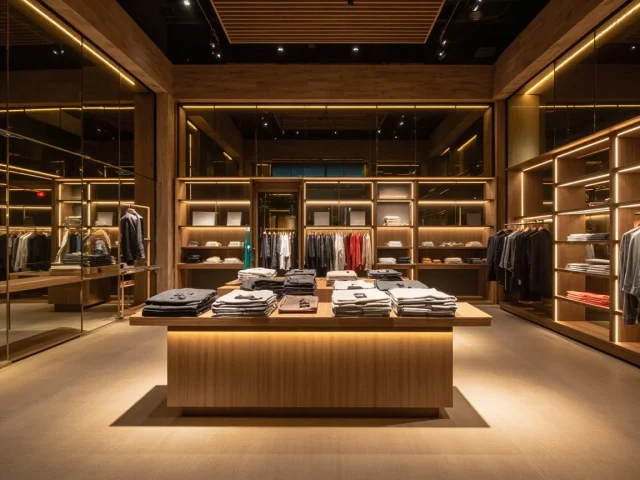
Most strong retail floors combine two: a hanging or folding feature near eye level to draw people in, with drawers underneath for depth of stock.
Hanging Presentation: Fixtures That Preserve Drape
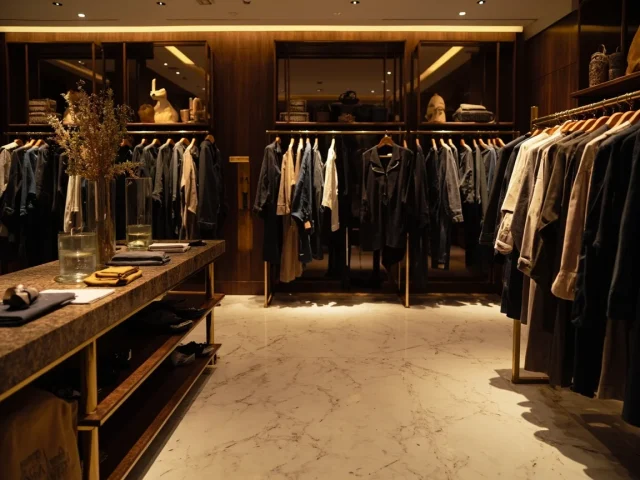
Hanging displays work when the support does not leave a crease. Two hardware choices dominate. A scarf bar or rail — typically 12–20 mm diameter in brushed brass or stainless steel — lets scarves be draped over the bar in offset layers. Allow 80–120 mm of horizontal rail per scarf, and keep the bar 1,200–1,400 mm from the floor so the hem sits below eye level and the scarf hangs clear. A scarf hanger or ring system uses individual hooks on a vertical frame; this suits boutique walls and gives one clear presentation per SKU, with a practical capacity of 8–12 scarves per 900 mm-wide panel.
Two details matter more than finish. First, rail and hook surfaces should be smooth with no burrs or sharp edges — a single snag on a 90 × 90 cm silk twill is a write-off. Second, avoid continuous-weight bars under thin glass; a loaded scarf rail should be mounted into the carcass or wall structure, not the display surface. For freestanding units, specify a weighted base or floor-fixing kit wherever footfall is high.
Folding Presentation: Compartments, Trays and Angled Decks
Folding is the most space-efficient option and the easiest to keep tidy across staff shifts. Standard folding in retail is a 4-fold or 8-fold rectangle measuring roughly 250 × 350 mm to 300 × 400 mm — a size that fits a standard tray and shows a corner of print and border.
Design the unit around that module. A tray-based folding deck with 300 × 400 mm compartments in a 3 × 2 or 4 × 2 grid gives 6–8 visible colorways per deck level. An angled display deck set at 15–25 degrees from horizontal lifts the far row into view and reduces the flat, warehouse look that kills perceived value. Use dividers — 4–6 mm acrylic, or flocked timber — rather than relying on neat stacking; dividers keep the grid intact through a full trading day and let staff restock fast.
If the folding deck is open to the aisle, finish the tray inserts in a matte suede-effect or flocked material. Gloss surfaces reflect store lighting and make scarf colors read inaccurately, which is the last thing a color-led category needs.
Drawer Presentation: Protection, Depth and a Sense of Ceremony
Drawers suit luxury scarf retail for two reasons: they protect product, and the act of opening one signals that the item is worth handling with care. Drawer internal depth of 80–120 mm handles most folded silks in two to three layers; deeper drawers of 150 mm plus suit bulky cashmere and wool. Plan internal widths in modules of 300–400 mm to match the folded size, and run full-extension runners rated to at least 25–35 kg for a loaded drawer.
Inside, line the base in a low-pile fabric and fit removable dividers so stock can be grouped by color or pattern. For high-value ranges, specify a lockable drawer or a soft-close runner, and consider a shallow pull-out tray above the main drawer that shows four to six highlight pieces without exposing the full stock. Lighting inside drawers is optional but effective — a 3,000–3,500 K LED strip at low output shows true color without glare, provided the cable route is planned at the design stage rather than retrofitted.
Materials, Lighting and Consistency Across the Rollout
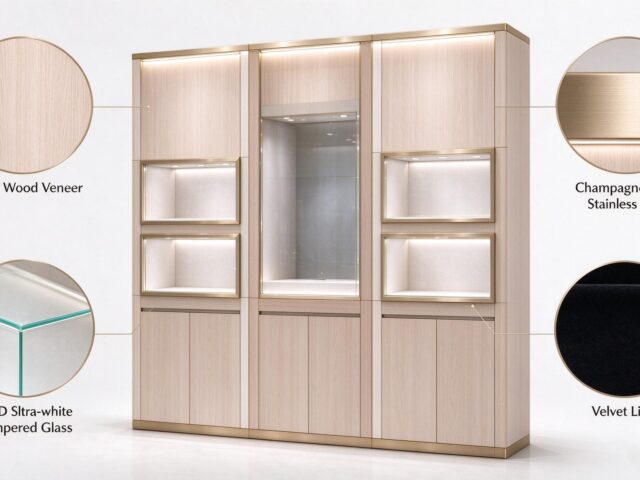
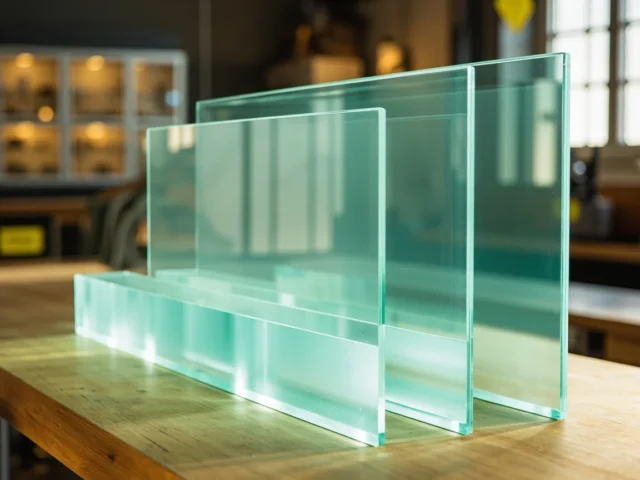
For mid-to-high-end retail, the reliable material set is a powder-coated or brushed metal frame, 10–19 mm tempered glass shelves where visibility matters, and timber or MDF carcasses in a matte lacquer or veneer. Keep to one metal finish and one insert fabric across the store, and specify locks, levelers and glass shelf pins as standard items on the parts list.
Lighting should be planned per category: a color rendering index of 90 or above is the practical minimum for silk and print, because lower CRI values shift blues and reds and customers notice. Place the light source in front of and above the product, not directly overhead, and keep heat away from natural fibers.
Finally, if the fixtures are part of a multi-store rollout, ask for dimensioned drawings, a finish sample set and a consistent bill of materials per SKU. Fixtures that look identical in a drawing but differ by 10 mm in drawer depth create restocking problems for years.
Working with a Manufacturer
Custom display work is a specification exercise before it is a manufacturing one. The brief that produces the best result is short and concrete: scarf sizes and folded dimensions, number of SKUs visible versus stored, interaction model, store footprint, power availability for drawer lighting, and target material and finish. With those inputs, a display manufactured to the store’s dimensions can be built in batches and shipped flat or assembled to suit installation conditions.
Libafang Showcase Co., Ltd., based in Guangzhou, produces custom display showcases and scarf fixtures for jewelry stores, watch boutiques, museums and luxury retail, exporting to more than 30 countries. Bring your drawn or written brief and the team will turn it into a dimensioned proposal you can price and install.
Request a free design and quote for your luxury scarf display fixtures — send your scarf dimensions, SKU counts and store footprint, and you will receive drawings, material options and pricing to match.