Museum display case procurement rarely fails at the negotiation table. It fails earlier, at the brief. A case that looks right in a render but leaks air, off-gasses solvents, or cannot be serviced without a five-person lift is a problem you discover after the objects are inside. Before you send drawings to three or four case makers and compare prices line by line, answer the questions below. They will help you compare like with like, avoid change orders, and give suppliers enough information to quote accurately the first time.
1. What is the case actually protecting?
Start with the collection, not the furniture. A Roman marble bust, a 1920s silk dress, and a mechanical watch movement have almost nothing in common beyond needing glass around them. For each display, write down object type, dimensions, weight, and whether it will be mounted, suspended, or resting on a deck. Note fragility: will it be moved by two people in gloves, or does it need a rigging plan?
This drives case size, deck construction, and access design. A 900 mm wide case with a lift-off bonnet is simple for two technicians in a small gallery. A 3 m wide case with a 200 kg stone object needs front access, joiner construction, and a floor-load check. Most cases fall into a few families: table vitrines (roughly 900–1,800 mm wide), wall cases, floor-standing cases 2,000–2,400 mm tall, and free-standing pavilions. Tell suppliers which family you need and why.
2. What climate and air-quality performance is required?
This is where quotes diverge most. Passive cases, sealed cases, and actively conditioned cases are three different products at three different price points.
Ask your conservator to state a target: for example, 45–55% relative humidity with a tolerance of ±5% over 24 hours, and a maximum internal pollutant level. Then ask suppliers to specify how they achieve it. Typical passive approaches use silica gel conditioned to target RH, sized by case volume and air exchange rate. A well-made gasketed case might run at 0.1–0.5 air changes per day; poorly sealed cases can exceed 2, which wastes desiccant and destabilizes RH.
Actively conditioned cases add a conditioning unit, ducting, and a control sensor. They cost more to buy, install, and maintain, so justify them where the object or loan agreement demands tight control. Ask about sensor placement, data logging, and how the system is serviced without opening the display chamber.
3. Which glazing, and what does it do to the budget?
Glazing is often 15–30% of case cost and the biggest driver of both visual quality and conservation protection. Specify the performance you need, then compare products.
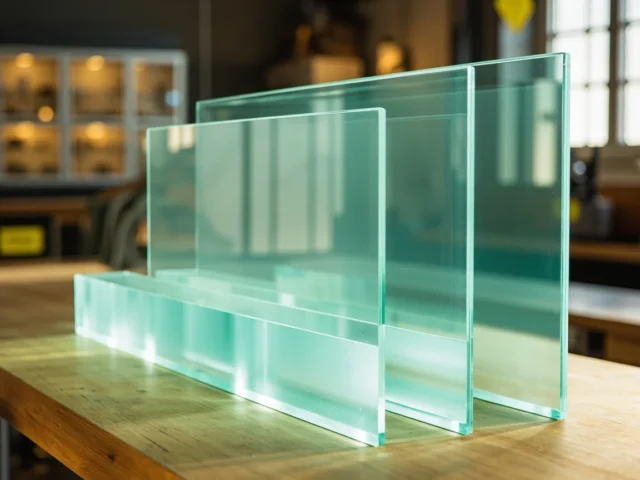
- Low-iron laminated glass: the default for clarity and safety; expect 6–10 mm laminates for most vitrines.
- UV-filtering interlayers: block most UV below 380–400 nm; essential for textiles, works on paper, and dyed materials.
- Anti-reflective coated glass: improves viewing under spotlights but costs significantly more and needs careful cleaning protocols.
- Acrylic: lighter and shatter-resistant, but scratches easily and builds static, which attracts dust.
Ask for glass thickness, laminate make-up, edge finish, and whether the supplier cuts, toughens, and laminates in-house or buys finished panels. That affects lead time and replacement cost.
4. How will the case be secured, opened, and serviced?
Security and access are operational questions. A case with a beautiful hidden lock is useless if the key holder is on another floor, or if opening it takes 20 minutes and two people. Ask:
- What locking system is used, and how many keys or credentials are supplied?
- Can the case be opened without moving the object or removing glazing?
- Where do sensors, lighting drivers, and desiccant trays sit, and how are they reached?
- What is the expected service interval for desiccant, filters, and seals?
Where tamper evidence or alarm integration matters, state the requirement in the brief. Suppliers can design cable routes and reed-switch mounting points into the case from the start, which is far cheaper than retrofitting.
5. What are the lighting and power requirements?
Decide whether lighting is integrated or external before quoting. Integrated LED systems need heat management, drivers, and cable routing inside the case. Ask for colour temperature (typically 3000 K or 4000 K), CRI (90+ for accurate colour rendering), and whether dimming is local or via a gallery control system. Fibre-optic or remote-driver options keep heat and electronics away from the objects. Confirm the voltage, plug type, and certification required in your country — this matters for imports, and it is a common source of delay at customs.
6. What does delivery, installation, and documentation include?
Request quotes with delivery terms stated clearly: FOB, CIF, or DDP, with named port. Confirm packaging (crate type, foam specification, moisture barrier), transit insurance, and whether installation is included or charged per day plus travel. Ask for the documentation package: shop drawings for approval, material certificates, glazing specifications, and an operation and maintenance manual. A case without a maintenance manual ages badly.
Finally, ask about tolerance and finish. State acceptable dimensional tolerance (for example ±2 mm on case dimensions) and finish samples for powder coat or veneer. Small mismatches between a render and a delivered case are normal; agreed samples and drawings prevent arguments.
Bring a complete brief to the first quote
The best procurement outcome is boring: three quotes that are genuinely comparable, one supplier selected on merit, and a case that performs for twenty years. To get there, supply object data, environmental targets, glazing performance, security and access requirements, lighting specs, and delivery terms in your request. Libafang Showcase Co., Ltd. builds custom museum and retail display cases in Guangzhou and exports to more than 30 countries, and can advise on specifications before you finalize the brief.
Ready to move from brief to budget? Send your object list, dimensions, and performance requirements for a free design proposal and quotation — no obligation, and we will flag any specification gaps before pricing.