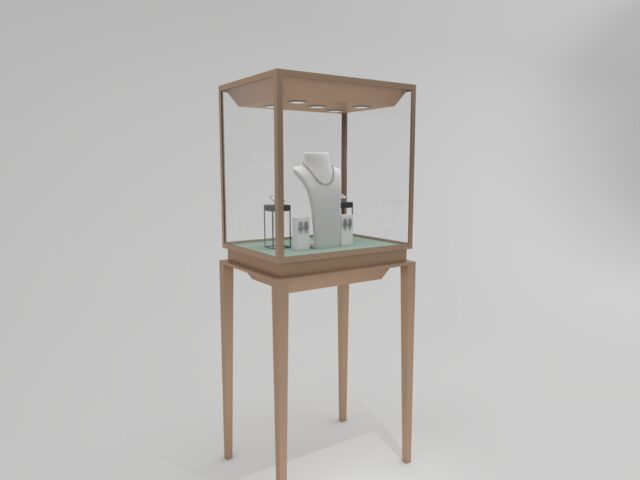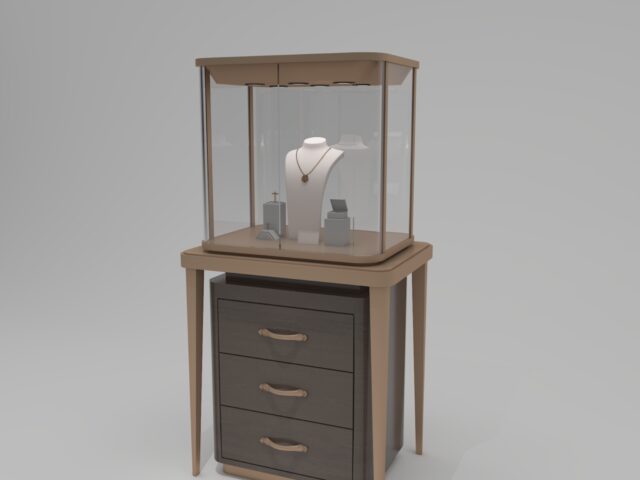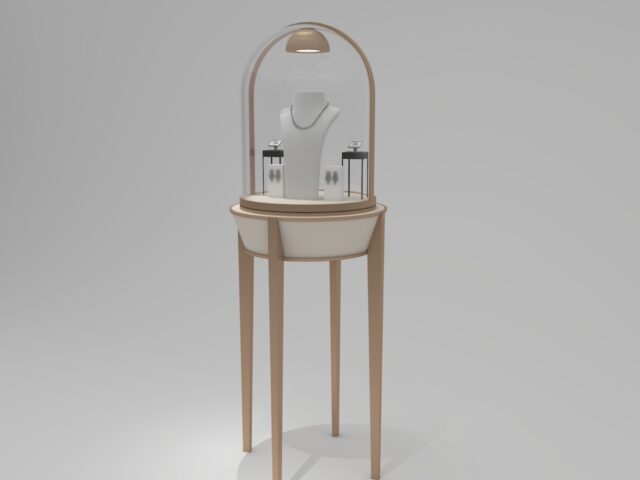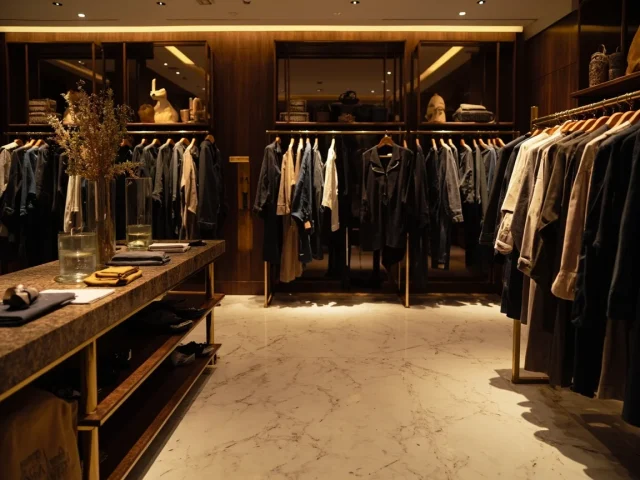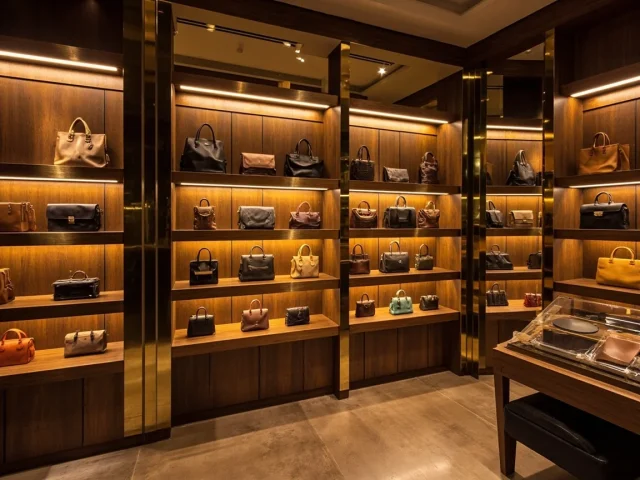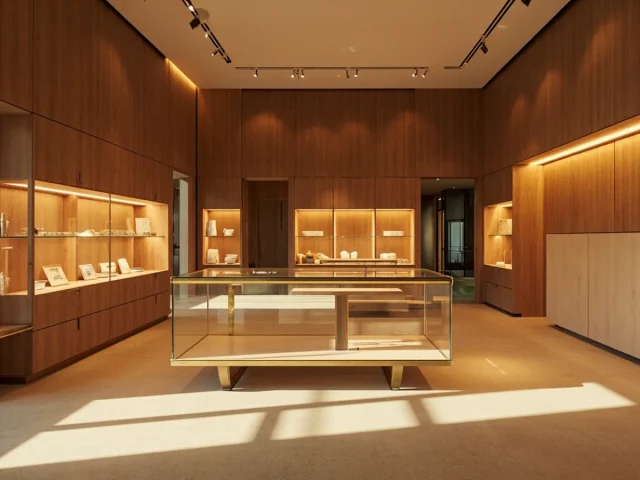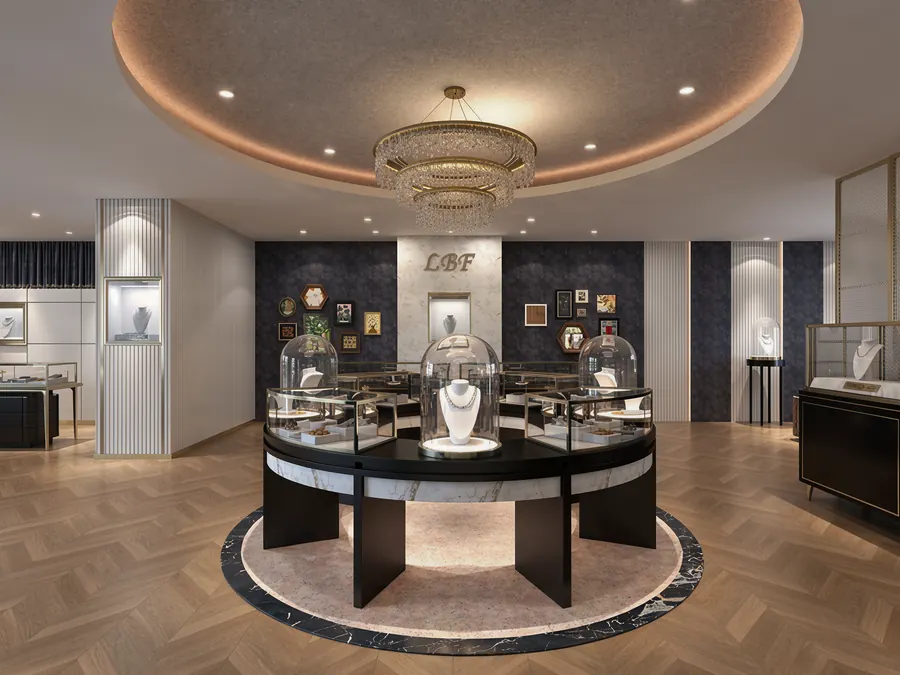
Estate jewelry is sold on provenance, condition and confidence — and every piece is different. A ring from a 1920s estate and a mid-century brooch may sit side by side in the same case, but they share almost nothing else: not metal, not era, not price, not the story that justifies the price. Generic display trays and a single printed price sheet cannot carry that weight. This is why estate jewelry display cases are built around the individual piece, not the collection: a dedicated position, a dedicated label, and a viewing angle that lets a customer examine detail without handling the object. Get that structure right and estate inventory becomes far easier to present, insure and sell.
Why Estate Jewelry Demands a Different Case Design
Retail jewelry display is usually built for multiple units of the same SKU. Estate is the opposite: high value per item, single units, and buyers who want to inspect maker’s marks, stones and wear patterns before they commit. A standard 1000mm-wide counter case might hold 30–40 loose pieces in trays, which is roughly 3–4 times too many if each item needs a readable label and adequate sightline. In practice, most estate retailers allocate one label per item and budget 80–150 cm² of visible top surface per piece, which often means 12–18 items per metre of case length rather than 30–40. Fewer pieces per case looks more curated, reduces clutter, and makes security easier to manage during the day.
Case geometry matters too. Brooches and necklaces need a near-vertical or tilted presentation so the face is visible from standing height; rings and earrings work better on a 15–25° incline. A single flat deck forces compromise. Modular inserts — felt-covered ring bars, angled easel blocks, necklace busts — let you reconfigure a case when the inventory mix changes, which for estate retailers happens every few weeks.
Designing Labels That Carry the Story
A label for estate jewelry has to do four jobs at once: identify the item, state the facts that build trust, tell the provenance, and show the price without making it the headline. Plan for a label of at least 60 × 40 mm; anything smaller forces 8-point type and customers over 50 will simply walk to the next case. Standard content order that works well:
- Title line: era, type and principal stone — for example, “Art Deco diamond plaque ring, circa 1925”.
- Facts line: metal and purity, carat weight, dimensions, condition grade.
- Provenance line: one sentence on origin or maker — the single most persuasive element in estate retail.
- Price and reference: price clearly set, plus an internal stock code for staff.
Use dark text on a light matte card, or light text on dark if the case interior is dark — contrast ratio matters more than branding. Anti-glare lamination costs little and prevents the label from reflecting the case lighting. If you plan to use digital price tags, keep a printed backup option in the design; battery changes and screen failures are common, and an unlabeled estate piece reads as unsold stock.
Lighting and Glare: Seeing the Detail
Estate buyers examine stones for replacement, settings for repairs and clasps for wear. Lighting that produces hard reflections defeats the purpose. Aim for 3000–3500K warm-neutral LED at a colour rendering index of 90 or above, with the source positioned at least 45° off the viewing axis. Use diffusers across the full light run rather than spot clusters; a diffuse wash at roughly 500–800 lux on the case deck is usually enough for detail without washing out colour. Add a dimmable circuit so staff can brighten a case for inspection and return it to display level afterwards. For cases near a shopfront, plan for window light as well — laminated low-iron glass in 6–8 mm thickness with an anti-reflective coating reduces double images and makes the label readable from the street.
Security Without Killing the View
Estate inventory is usually the highest-value stock in the store per square metre, so cases need real security that does not read as hostile. A practical specification for estate jewelry display cases typically includes:
- 8–10 mm laminated glass tops, with tempered glass on the front and sides.
- Concealed cam locks or central locking bars, with keys held off the sales floor.
- Steel reinforcement in the frame rather than aluminium alone, and anchored feet or base plinths.
- Soft-close hinges and lift-assisted lids so staff can open the case one-handed while watching the customer.
- A tamper-resistant cable route for alarm sensors, kept out of the customer’s sightline.
The trade-off is weight and cost: a 1500 mm estate counter case with laminated tops and steel framing may run 120–180 kg, so check floor loading and plan delivery access before ordering. Cheaper in the short term, lighter cases often flex under repeated opening and show gaps within two years.
Layout, Inventory and Reconfiguration
The most useful feature in an estate case is adjustability. Choose a system of 25 mm or 50 mm pitch shelving and insert rails so ring bars, necklace busts and easel blocks can be repositioned without new cabinetry. Keep the base storage shallow — 200–250 mm depth — so staff can reach trays without crouching, and use felt-lined drawers for pieces awaiting photography or repair. Sizing cases in 600 mm and 900 mm modules rather than one long run gives you the flexibility to break a display into categories: rings on one side, brooches and pendants on the other, each with its own label line and lighting circuit.
Libafang Showcase Co., Ltd. builds custom cases in Guangzhou for jewelry and watch retailers, museums and luxury retail clients, producing to buyer specifications and shipping to more than 30 countries. For estate retailers, the usual approach is a set of modular cases with interchangeable inserts, a printed label template sized to the buyer’s own system, and a lighting plan matched to stone colour.
Before You Order: A Short Checklist
Confirm the number of items you display at peak, the largest and smallest item dimensions, your label format and size, and how often the inventory mix changes. Ask for a sample label holder and a felt swatch before signing off, and specify the service access route for LED drivers and locks. Getting these details settled up front is what separates a case that still works in year five from one that needs replacing in year two — and it is the difference between a display that merely holds estate jewelry and one that actively sells it.
Request a free design and quote from Libafang with your case dimensions, item count and label requirements, and get a layout drawing and cost estimate for your estate jewelry display cases.