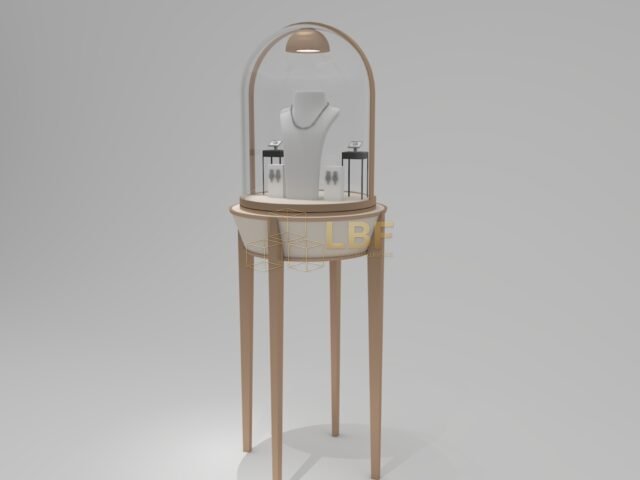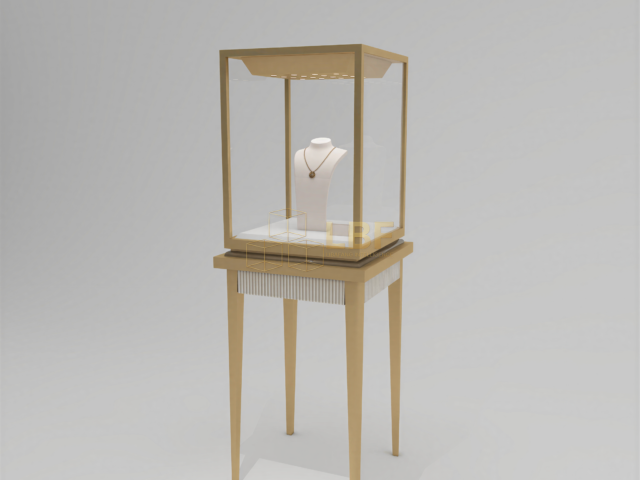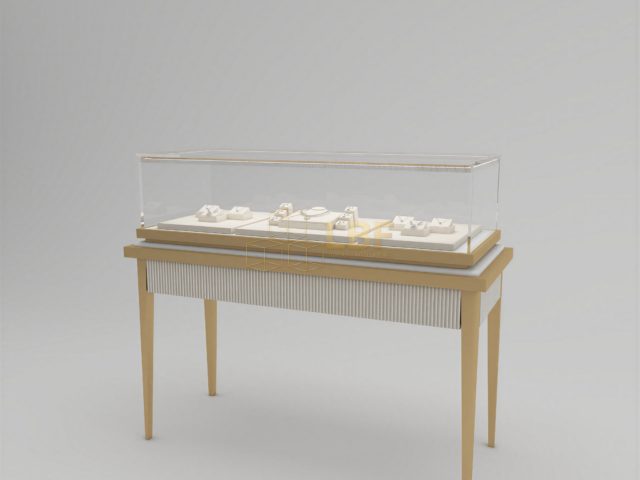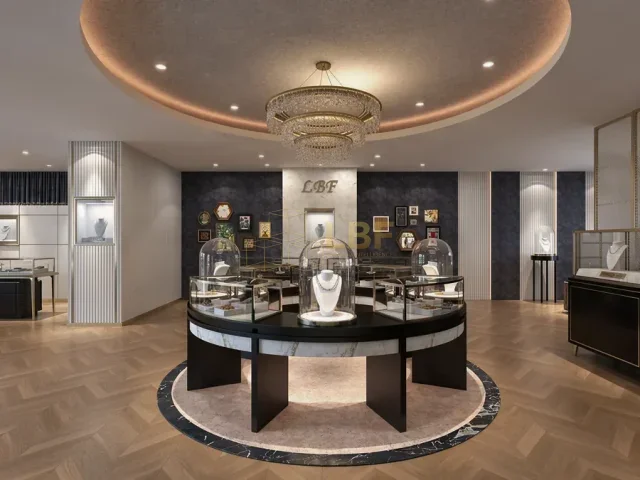
Most jewelry showcase projects are planned around size, finish and glass — and then electrical detail is confirmed late, after the deposit is paid. That ordering causes expensive problems: a display built for 220V arriving in a 120V market, a plug that cannot be used without an adapter visible to customers, or a certification mark the local electrical inspector will not accept. Because jewelry showcase electrical requirements differ by destination market in voltage, frequency, plug type, safety certification and documentation, they need to be settled at the drawing stage, not at crating. Below are the points worth confirming with your buyer before a single LED strip is cut.
Confirm voltage, frequency and the actual supply on site
Start with the destination country’s nominal supply. Most of Europe, China, Australia, India and the Gulf states run 220–240V at 50Hz. The United States, Canada, Mexico, Japan (partly) and much of Latin America run 110–120V at 60Hz. Japan is the awkward case: 100V, with 50Hz in eastern regions and 60Hz in western ones.
Nominal voltage is not the whole story. Ask for the measured voltage at the retail location, because a mall anchor tenant can sit at 208V three-phase in North America while a standalone store is at 120V. Also confirm whether the showcase will run on wall sockets or hardwired circuits, and whether the store uses a 3-wire plus ground layout. LED drivers are usually rated for wide input, but the label and the certification must match the market, not just the driver’s capability. Specify the exact input voltage and frequency on the purchase order so there is no argument at delivery.
Decide the plug and connection method before the build
Plug type is a visible detail that affects the shopping experience. A US-style NEMA 5-15 plug on a 220V European showcase is both unusable and unsafe. The main types to plan around:
- Type A/B (NEMA 5-15): 120V, North America, Japan with adaptation, parts of Central America.
- Type C/F (Schuko): 230V, most of continental Europe.
- Type G: 230V, United Kingdom, Ireland, Singapore, Hong Kong, UAE, Saudi Arabia.
- Type I: 230V, Australia, New Zealand, China, Argentina.
- Type J/K/L/M/N: 230V and 220V, Switzerland, Italy, Denmark, Brazil, Israel, South Africa respectively.
Also decide whether each showcase gets an individual cord and plug, or whether the run is hardwired to a junction box under the counter. Hardwiring is cleaner for long continuous glass cases but requires an on-site electrician and normally a local disconnect. For retail fit-outs that may be reconfigured, plug-and-play per unit is usually simpler. Whichever you choose, confirm whether the buyer wants the earth pin connected to the showcase chassis and where the power switch is positioned — behind a door, at the rear, or on the counter-side face.
Match LED load, driver and total circuit capacity
Jewelry display lighting is low power, but it adds up. A typical vitrine might use 6–10W of LED strip per shelf plus 20–30W of spot or track heads, giving 40–70W per case. Ten cases on one circuit is 400–700W, which sits comfortably on a 10A/230V circuit (2300W) but needs checking on a 15A/120V circuit (1800W nominal, derate to about 1440W for continuous load). Keep total connected load at or below 80% of breaker rating.
Ask the buyer whether they want one driver per showcase, a shared driver bank in the base, or central dimming from a counter or back-of-house location. Remote drivers reduce heat inside the glass box and make servicing easier, but they add low-voltage cable runs that must be voltage-drop checked — keep 24V runs under about 10m unless cable gauge is increased. If dimming is specified, confirm the protocol: trailing-edge mains dimming, 0–10V, DALI or a proprietary app-based system. Lighting control protocol should be written into the specification, because retrofitting dimming after the fact usually means new drivers. Also confirm colour temperature and CRI targets; 3000K to 4000K with CRI 90+ is standard for jewelry, and mismatched batches are a common complaint.
Check certification marks and documentation for the destination
Every market has its own conformity path, and a showcase shipped without the right mark can be held at the port or rejected by a mall’s electrical contractor. The common ones:
- CE with a Declaration of Conformity — EU and EEA. LED drivers need the relevant EN standards.
- UKCA — Great Britain, still required alongside or instead of CE depending on current rules.
- UL or ETL listing — United States and Canada; UL 962 covers furniture, and the lighting components each carry their own listing.
- CCC — China for certain categories; RCM — Australia and New Zealand.
- SASO / G-Mark — Gulf states; PSE — Japan; KC — Korea.
Beyond the mark, prepare an instruction manual in the destination language, a wiring diagram inside the base or door, a bill of materials, and a conformity or test report pack. Museums and luxury brands often add their own fire and electrical specifications on top of national rules, so request their facility guidelines early. For projects shipped into the US and EU, Libafang plans component selection around the buyer’s required marks from the drawing stage, which is cheaper than resourcing parts later.
Plan for servicing and on-site adjustment
Assume the showcase will need lamp changes without dismantling it. Confirm that drivers, connectors and dimmers are reachable through a service panel or removable base, and that spare components — drivers, connectors, a length of matching LED strip — are included in the shipment. For multi-store rollouts, standardise the driver model across all units so a single spare covers the estate.
Finally, ask who commissions the electrical work on site. The supplier typically delivers tested, tagged showcases, but final connection and any hardwiring fall to the local contractor. Make that split explicit in the contract, and include a factory test record for each unit. Documenting the jewelry showcase electrical requirements in the signed drawings protects both sides and speeds up customs and mall approvals. If you are planning a rollout and want the electrical specification matched to your market, send your destination, voltage, plug type and certification needs to Libafang for a free design and quote.