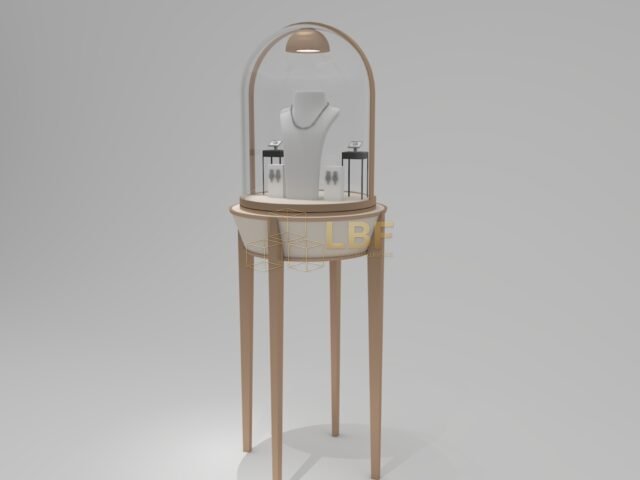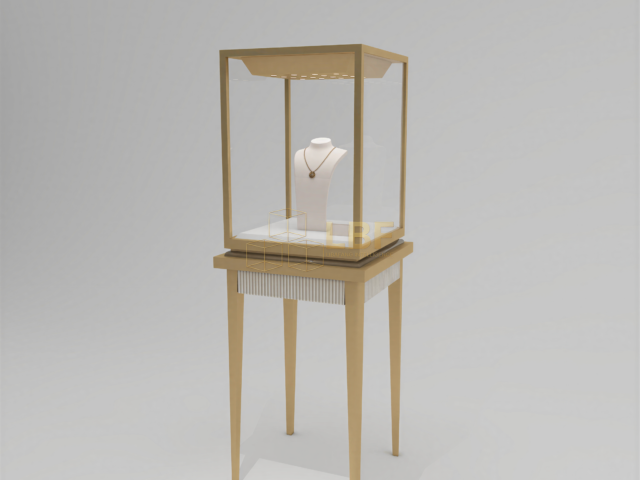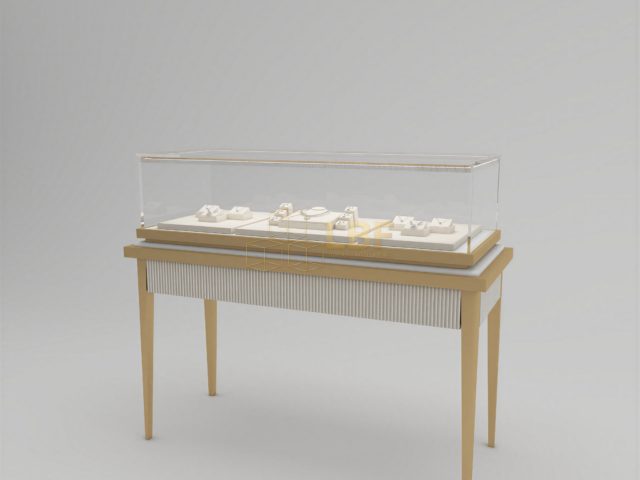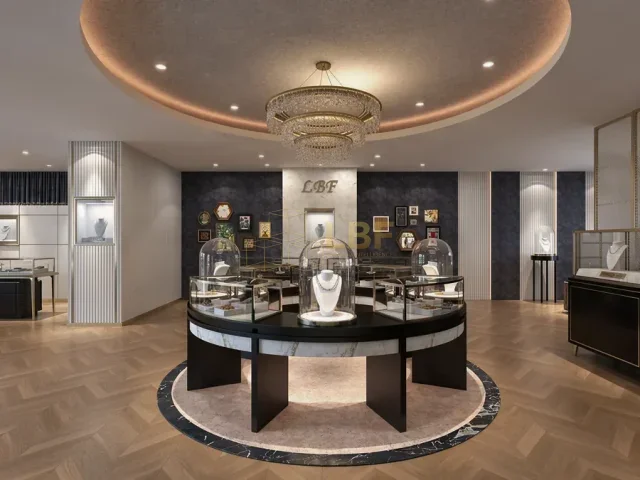

Most buyers judge a display cabinet by its finish and lighting. Jewelers, watch boutiques and museum conservators judge it by the hardware they cannot see, because that is what determines whether the doors still sit flush after 200,000 open-and-close cycles and whether the glass stays haze-free around the pivots. A display case runs on a different duty cycle than residential cabinetry: it is opened many times a day by staff wearing gloves, it is often locked, and it may stand within 300 mm of a customer’s face. This article covers the three hardware decisions that separate a durable luxury display cabinet from one that needs adjustment every quarter: concealed hinge spec, drawer slide spec, and serviceability design.
Why concealed hinges behave differently on glass-and-metal cases
The first mistake is treating the door of a jewelry showcase like a kitchen cabinet door. A single tempered glass door of 8 mm thickness on a 600 × 900 mm frame weighs roughly 12 to 15 kg, roughly twice an MDF door of the same size. Milled aluminum and brass frames add more. That weight sits on two or three hinge cups, and every opening transfers a small lateral load into the frame.
For this reason, most quality display cases use European-style concealed hinges with 35 mm cup diameter and 52 mm hinge-hole pattern, but in a heavier-duty grade: an integrated soft-close damper, at least a 110° opening angle, and steel rather than zinc-alloy hinge arms. Brass and zinc-alloy arms corrode around the ammonia-based cleaning agents used in jewelry showrooms; stainless and nickel-plated steel do not. Hinge hole spacing should be checked against the frame extrusion before production, because a 2 mm deviation in the cup position shows up as a 2–3 mm door gap at the opposite corner once the weight is loaded.
Adjustment range matters as much as load capacity. Specify three-way cam adjustment of at least 2 mm per axis, so that a door that has shifted after a year of humidity cycling can be brought back to an even 3 mm reveal without removing the doors. Glass doors with no framing on the hinge side should use hinge plates bonded with a structural adhesive rated for glass, not drilled into the edge.
Drawer slides: match the load rating to the loads you actually expect
Tray drawer slides are usually the first hardware to fail in a watch or jewelry display, because trays are loaded unevenly. A 500 mm wide show drawer holding felt trays may carry only 6 kg, but that load sits 80 percent toward the front, which magnifies the rolling resistance and accelerates wear. Use full-extension slides only where staff need to reach the back of the drawer; partial-extension slides waste 20–30 percent of usable depth.
- Light trays (up to 10 kg): 27 mm partial-extension ball-bearing slide, zinc-plated steel, 35–45 mm stroke per 100 mm of depth as a budget choice.
- General display drawers (10–25 kg): 35 mm full-extension ball-bearing slide with a load rating of 35–45 kg per pair; derated to roughly 60 percent when mounted horizontally in casework.
- Heavy vault drawers (25–50 kg): under-mount slides with synchronized self-closing, 45 kg rating minimum, plus a secondary stop.
- Under glass-top cases: undermount slides are quieter and avoid the metal strip visible on side-mount designs.
All slides should be pre-drilled at 32 mm system spacing, which makes replacement with parts from any European supplier possible. A well-specified ball-bearing slide should return an expected 50,000 to 80,000 cycles; ask your supplier for a test figure rather than taking ‘heavy duty’ on trust.
Soft-close, self-close and locking: interactions to plan early
Concealed hinges with dampers and drawer slides with self-close mechanisms solve different problems, but they interact. If a glass door is fitted with both a damper hinge and a magnetic lock, the damper must be the kind that resets at about 20–25° so the last segment engages the lock pin cleanly. Mismatched components produce doors that stand 1–2 mm proud or, conversely, that need a firm push before the lock bolt drops.
Lock placement deserves equal attention. Cam locks of 20 mm length are standard in display casework, but where the cabinet has a central locking bar rather than individual locks, the bar mechanism must be accessible from a single key point and must transfer motion to every drawer within 0.5 mm of play. Plan for one keyed lock per 4–6 drawers rather than per case.
Designing for serviceability before the first cut
Hardware access is a design feature, not an afterthought. A showcase that requires eight screws and two people to replace a hinge will be repaired late, badly, or not at all. The practical rules are simple: leave at least 40 mm of clear space behind each hinge plate and drawer slide, route cables and LED drivers in a separate channel from moving parts, and specify connectors rather than hard-wired LED strips (USB-C barrel connectors of 12 V, 2 A rated are increasingly common).
Spare-part strategy matters as much as access. Keep two spare hinges, two spare slide sets and one spare lock per 20 cabinets installed on a floor. Standardize on one hinge cup pattern and one slide brand across the range so a parts bin actually fits. Publish a service label with a model number inside the case; it makes a 10-year-old cabinet’s hardware orderable.
Quality control checks to write into the purchase order
Concrete acceptance criteria turn a vague promise into a specification. Ask for 25 mm glass of at least 6 mm thickness with optically clear float, and specify that paper test measurement of door alignment be within 2 mm at all four corners after full load. Cycle-test ten doors and ten drawers at 100 cycles for durability and re-check alignment; a correctly fitted hidden hinge should not drift more than 0.5 mm. Test dust ingress at the hinge line with a 10-minute dust chamber exposure and inspect for grit in the cup. Finally, ask for the manufacturer’s hardware data sheets, not just a photo of a finished cabinet.
At Libafang, these checks are part of the standard build sheet for every case, whether it is a single ring showcase or a 30-case museum run. If you are planning a store fit-out, request a free design and quote and we will include a hardware schedule with cycle ratings, load limits and a suggested spare-parts list for your project.