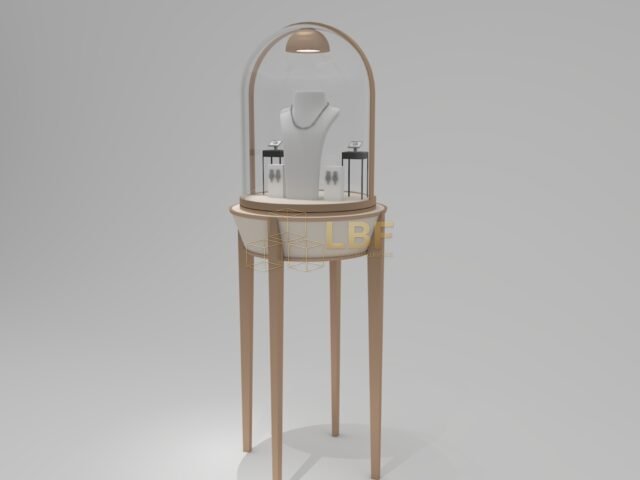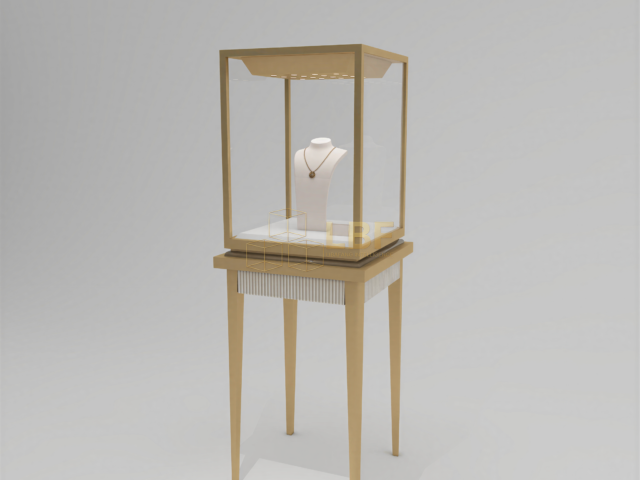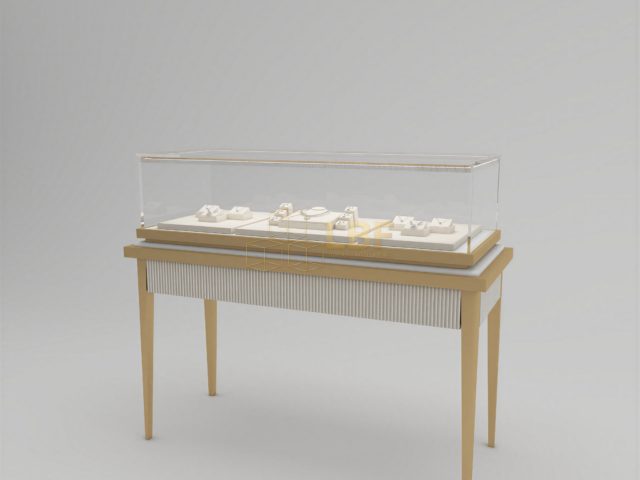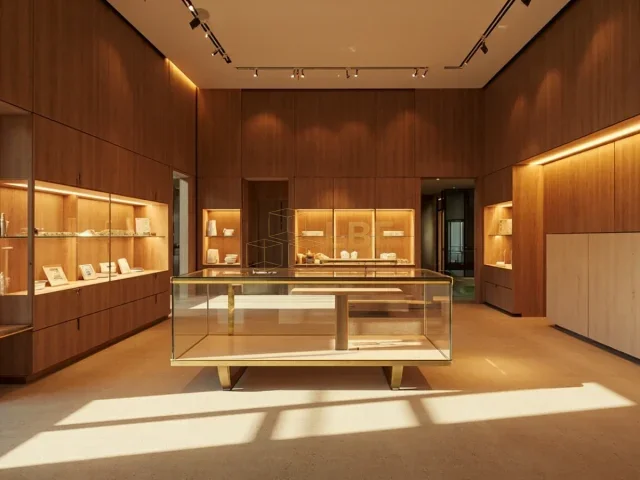
Most museum display case failures are not lighting failures or material failures. They are geometry failures. A case can be beautifully made, hold a 2,000-year-old seal or a 12 mm watch movement, and still leave visitors bending, squinting and walking away. The problem is that viewing angles were never planned — the case was designed in plan and elevation, but not from the eye of a 1.55 m visitor standing 45 cm away. Small objects and fine details demand a more deliberate approach, because every degree of tilt and every centimetre of case height changes what the eye can resolve. This guide covers the practical numbers that matter when specifying museum display case viewing angles for small, detail-rich objects.
Start from the sightline, not the case
Before choosing glass or LED, define the primary viewing distance and eye height. For standing displays, assume a visitor eye height range of roughly 1.45 m to 1.80 m, with a design target of 1.55 m. For seated visitors and wheelchair users, eye height drops to about 1.10 m to 1.25 m. A small object that sits below 900 mm from the floor excludes a large share of your audience from seeing its top surface.
The critical viewing cone for detail work is generally 30 to 45 degrees from the horizontal at the object plane. If visitors must look up at more than about 20 degrees, backs of objects and recessed details disappear. If they must look down steeply — beyond roughly 60 degrees — specular glare from overhead lighting becomes almost unavoidable. Aim to place the object’s top surface within a 20 to 40 degree downward viewing angle for standing adults, and around 30 to 45 degrees for seated visitors.
Height, tilt and the numbers that work
For small objects — coins, seals, carved gems, insects, watch movements, jewelry settings — the object should sit close to eye level minus the viewing angle. A practical rule of thumb: place the centre of a small object at 1,050 to 1,250 mm above finished floor for standing display, and 800 to 950 mm for seated or mixed audiences.
Where you cannot lower the case, tilt the object plane. A 15 degree tilt toward the viewer recovers details lost at higher mounting heights without dramatically increasing case depth. A 20 to 30 degree tilt is common for tabletop cased jewelry and small artifacts; beyond 35 degrees, gravity, mounting integrity and glare risk all rise.
- Small objects under 150 mm: centre at 1,050–1,200 mm, tilt 10–20 degrees
- Objects 150–400 mm: centre at 1,000–1,150 mm, minimal tilt needed
- Seated-primary displays: centre at 800–950 mm, tilt 15–25 degrees
- Wall cases with fine details: base at 900 mm minimum, top insert below 1,800 mm
- Maximum acceptable head clearance at top of glazing: 1,900 mm for children’s view is not guaranteed below 1,750 mm
The object plane to glazing distance also matters. Keep at least 75 mm between the front face of a detailed object and the inner glazing surface. This reduces reflection of the viewer’s own face across the object and gives a small buffer for mounting adjustments.
Glazing, glare and the angle you didn’t plan for
Reflections follow the law of reflection: the incident and reflected rays are equal in angle. The most common specular problem is a bright ceiling or wall behind the visitor, reflected directly back into the eye at the same angle they are viewing the object. With a typical 30 degree downward view and a ceiling luminaire 1.5 m in front of the case, glare becomes visible at specific visitor positions.
Mitigations that work with viewing angles: use low-reflectance anti-reflective glass or acrylic (reflectance typically under 1% to 2% for AR-coated glazing versus about 8% for uncoated float glass), keep the internal case background matte and mid-to-dark toned, and avoid placing bright wall text or lighting directly behind the visitor’s standing position. Tilted glazing at 5 to 10 degrees — sloping the top of the front panel toward the viewer — noticeably reduces reflected sightlines for high-mounted cases. It also increases fabrication complexity, so specify it early.
Light, detail and the eye’s limits
Fine detail visibility is not just about angle. The human eye resolves contrast, not absolute lux. For small engraved or textured objects, target 200 to 300 lux on the object surface with a CRI of 90 or higher; for sensitive materials, stay within your conservation policy while increasing local contrast with directional light rather than intensity. Light from an oblique angle — 25 to 35 degrees above the object plane — brings out relief and engraving detail far more effectively than flat frontal illumination. Keep luminaires outside the reflective angle of the glazing so visitors do not see the LED source itself.
The viewing envelope also separates jewellery from sculpture: a 15 mm diamond set requires higher illuminance, closer working distance and more careful glare control than a 400 mm ceramic vessel. If one case serves both, you cannot optimise both. Split them or accept the compromise — and tell the client explicitly which one has been prioritised.
Mock-up and sign-off
Never sign off on a small-object case from drawings alone. Build a 1:1 mock-up with the actual object, or a surrogate of similar size and colour, at the real viewing height. Check it from 1.45 m, 1.55 m and 1.80 m eye heights, and from a seated position 600 mm away. Walk across the viewing arc and record where glares or occlusions appear at 15 degree intervals around the case. These observations convert directly into tilt and mounting adjustments before metal is cut.
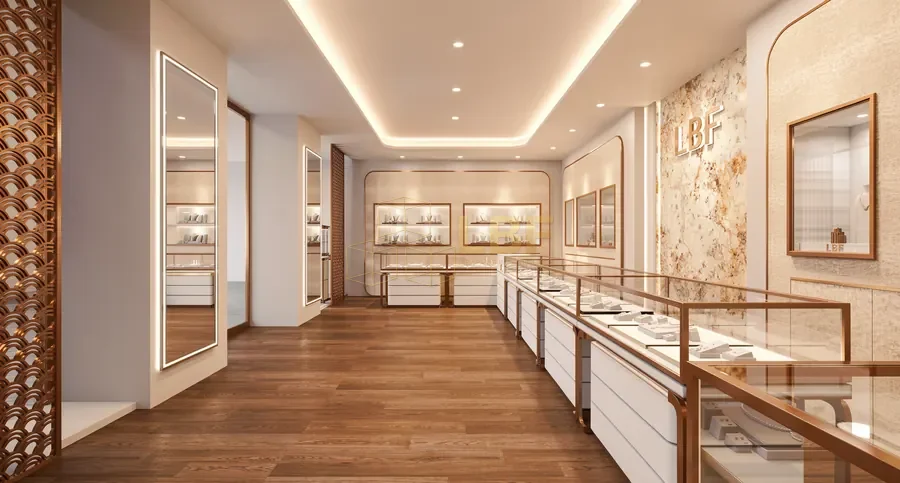
Libafang, a Guangzhou manufacturer of custom display showcases, routinely builds these mock-ups for museum and jewellery projects exported to more than 30 countries, so viewing geometry and lighting can be validated before production.
Putting it into the brief
The most durable fix is to write the numbers into the brief: primary eye height, minimum and maximum viewing angles, tilt range, object plane to glazing gap, and the minimum illuminance at the object surface for detail recovery. Force the designer and fabricator to answer each in writing. Small objects do not fail because a museum display case is badly made — they fail because nobody specified the angle at which they would be seen. Get the geometry right, and the glass, lighting and conservation details become far easier problems to solve. Contact Libafang to request a free design and quote for your next small-object or fine-detail display case project.