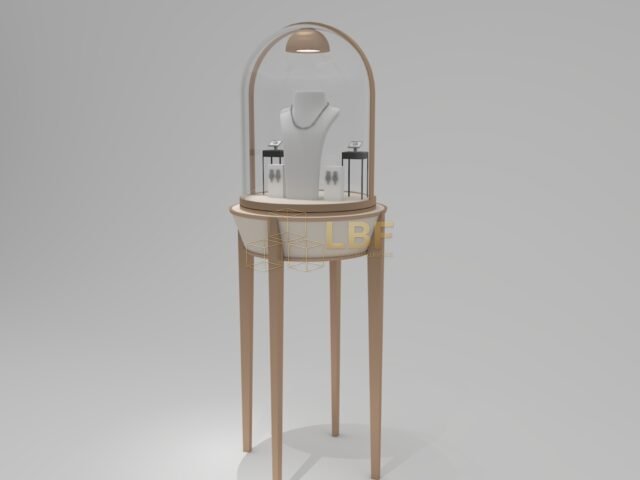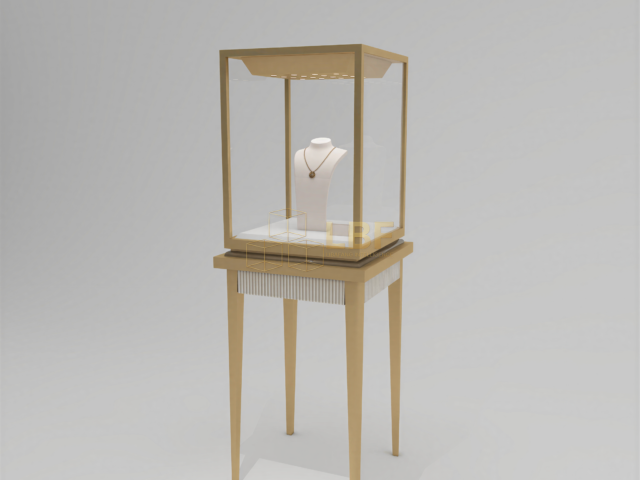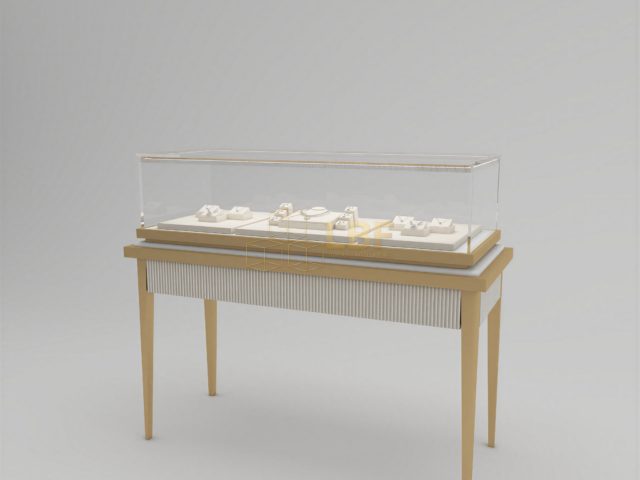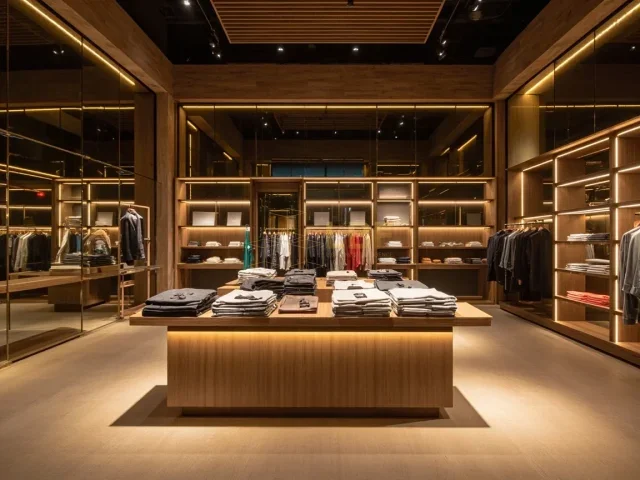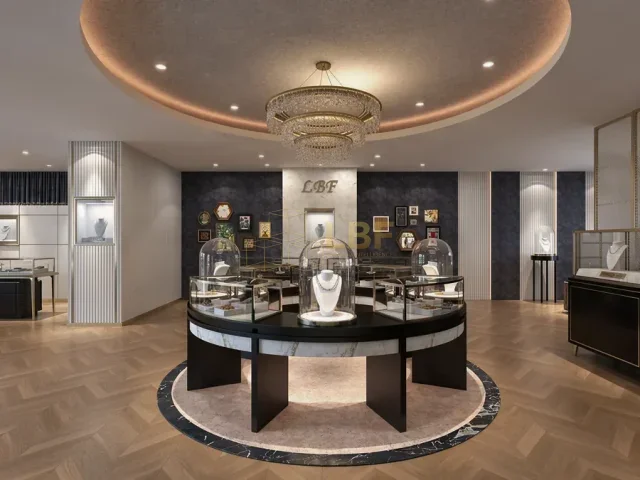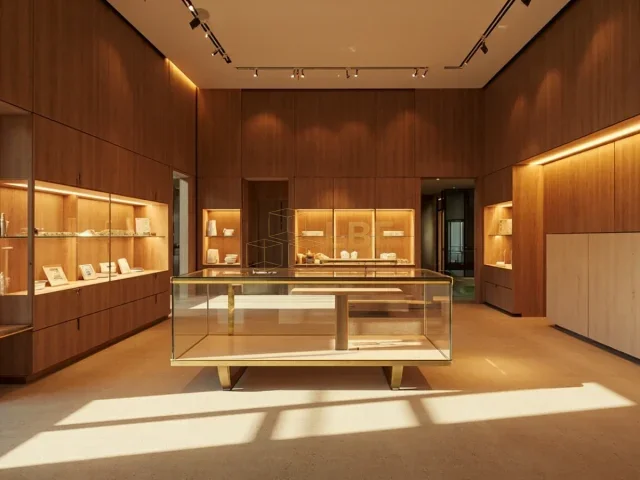
A customer rarely walks straight to a display case. They enter, pause for 2–4 seconds, scan the room from a standing height of about 1.5–1.7 m, and decide where to go. If your best piece is hidden behind a column, blocked by a cash wrap, or angled away from the inbound sightline, you lose the sale before anyone reads a price tag. Luxury display cabinet sightlines are the geometry of that first scan: what a shopper can actually see, from where, and how much of the product reads as desirable rather than as glass glare or a reflection of the door.
This article gives store planners, brand managers, and shopfitters a practical method for checking cabinet sightlines from entrances and aisles, with numbers you can apply during a site walk or a drawing review.
Start from the real entrance eye-line, not the plan view
Floor plans are drawn from above; shoppers see from the side. Before adjusting any cabinet, stand at the main entrance threshold and note two eye heights: approximately 1.55 m for an average shopper and 1.70 m for taller visitors. Then mark the natural stopping points — usually 1.5–2.5 m inside the door, at the security pedestal, and at the first aisle junction.
Draw three sight cones on your plan from those standing points, each about 60–90 degrees wide, and shade where structure, columns, feature walls, or high fixtures break them. Any licensed jewelry or watch cabinet that falls outside those cones should be re-laid-out or reassigned to secondary product. As a rule, your anchor case should sit within 15 degrees of the direct entrance axis and inside the first 6–8 m of view.
The vertical window: make sure the product sits in view
The vertical sightline matters as much as the horizontal one. A shopper seated or leaning in looks down; a shopper walking past looks level. Use these reference bands for cabinet internal layout:
- Prime band, 1.20–1.65 m: hero items, high-value watches, and single-stone rings. This is where a standing customer’s eye rests first.
- Secondary band, 0.90–1.20 m: bridal sets, price-point jewelry, and pieces that reward a lean-in.
- Lower band, below 0.90 m: boxes, packaging, layaway items, or a shallow plinth — this zone is often obscured by reflections or the customer’s own body.
If a 2 m-high cabinet places its best shelf above 1.7 m, only tall visitors see it, and the merchandise above eye level can also create dark bands from overhead lighting. Cap decorative illumination at roughly 3,000 K with tight beam control so that the top shelf does not flare in the entrance sightline.
Distance, angle, and the 10-second legibility test
Sightlines degrade with distance. A watch dial that reads clearly at 0.4 m becomes an indistinguishable disc at 3 m. Test every anchor cabinet from the entrance at the actual distances shoppers will stand, then repeat from 45 degrees and 30 degrees off-axis. If the hero product cannot be identified as a jewelry piece within 5–10 seconds, the case is doing display work, not sales work.
Two practical rules help. First, keep the cabinet’s front face within 30 degrees of perpendicular to the main approach path; beyond that, glass reflects ceiling lights rather than showing product. Second, keep at least 1.2 m of clear standing space in front of any case you want people to stop at — crowded aisles push shoppers past rather than closer. In narrow stores (under 4.5 m wide), angle the front of the cabinet 10–15 degrees inward toward the entrance so the visual face turns toward arriving foot traffic.
Glass, lighting, and glare from the door
Most sightline failures are not layout failures but reflection failures. An entrance door at 10–20 degrees to the south or west can throw a bright rectangle across a cabinet face for several hours a day. Low-iron or anti-reflective laminated glass reduces this moderately, but geometry does more work than coating. Aim display beams at the product, not the back pane, keep downlights 0.6–1.2 m forward of the case face, and use a 24–36 degree beam angle so the beam lands on the shelf rather than the glass.
Where an entrance reflection cannot be designed out, place a matte back panel behind the hero product. A busy background outside the cabinet fights the item; a quiet one extends its apparent contrast, and that contrast is what makes a case legible from 6 m away.
A site-walk checklist for entrances and aisles
- Stand at the entrance threshold and photograph three viewlines: straight ahead, 30 degrees left, 30 degrees right.
- Mark any cabinet that is not visible from the main entrance and confirm with a 10-second identification test of the hero item.
- Measure standing height and shelf band on every anchor case; move hero items into 1.20–1.65 m.
- Check the first 6 m of aisle from the entrance for blocking fixtures, signage, and promotional plinths.
- Walk each aisle at normal speed and record where the eye first lands on product versus glass reflection.
- Confirm a clear standing zone of at least 1.2 m in front of every stop-and-look case.
- Repeat the check in early morning and late afternoon light, and again after dark with interior lighting on.
Designing cabinets that pass the test before delivery
Sightline problems are cheapest to fix in the drawing and sample stage, not on site. A manufacturer should be able to provide front elevation, plan, and section views with the internal shelf heights and lighting positions marked, so you can check the 1.20–1.65 m prime band and glass angles before anything is cut. Ask for a 1:10 section through the hero shelf with the beam path drawn; it takes minutes to review and prevents a case that looks premium in a showroom and flat from the entrance.
Libafang builds custom glass and metal display cabinets for jewelry, watch, museum, and luxury retail projects, with drawings and samples reviewed for sightline geometry before production. For new-build projects and refits, include sightline checks as a sign-off item alongside dimensions and finishes.
Send us your floor plan, entrance position, and anchor product list, and we will suggest cabinet heights, angles, and lighting positions for your key sightlines — then provide a free design and quote for the cases you need.