Light is the most contradictory tool in a display case. It lets a visitor see the facets of a diamond or the crackle glaze on a Ming vase, and at the same time it slowly destroys both. Museum-grade lighting exists to resolve that contradiction: it delivers high color fidelity and precise beam control while keeping UV, heat and cumulative exposure inside conservation limits. Get it right and a 17th-century oil painting can stay on view for decades. Get it wrong and the same canvas shows visible fading in under two years.
What “Museum-Grade” Actually Means
The term gets used loosely in retail, so it helps to define it by measurable criteria rather than mood. A fixture qualifies as museum grade when it meets four thresholds at once.
- UV output below 75 µW/lm, and ideally under 10 µW/lm for textiles, watercolors and dyed leather.
- No infrared in the beam, so radiant heat reaching the object stays negligible. LED sources with a well-designed heat sink keep surface temperature rise under 2°C.
- Color rendering (CRI) of 95 or higher, with R9 (deep red) above 90 — critical for rubies, red lacquer and oil paintings.
- Dimmable, dim-to-warm or tunable output with no visible flicker (flicker percent below 5, or ideally below 1).
Museum conservators also track cumulative exposure, not just instantaneous brightness. Light damage is dose-dependent, which is why the same 50 lux that is harmless for an hour becomes a problem at 3,000 hours.
Lux Limits by Material — The Numbers to Work From
These are widely used conservation guidelines, and they are a sensible starting point for any jewelry, watch or museum showcase project.
- Highly sensitive: textiles, costumes, watercolors, manuscripts, dyed feathers, some photographs — 50 lux, UV under 10 µW/lm.
- Moderately sensitive: oil and tempera paintings, wood, ivory, bone, leather, horn — 150 to 200 lux.
- Least sensitive: stone, metals, glass, ceramics, enamel, most gemstones and precious metals — 300 lux, though heat and glare still matter.
For luxury retail the numbers usually run higher because the goal is sales as well as preservation. A common compromise for watch and jewelry cases is 800 to 1,200 lux on the product with tightly controlled spill, since the pieces are metal, stone and sapphire crystal — chemically stable under light. The mistake is applying retail brightness to a vintage watch with a painted dial, where the lume and printing can shift noticeably at that level.
Why LED Changed the Game — and Where It Still Falls Short
Twenty years ago, museum lighting meant halogen or filtered tungsten, plus UV-filter sleeves and frequent lamp replacement. LEDs removed most of the UV and IR problem in one step and cut power draw by 60–80% for the same delivered light. They also made beam shaping possible: a 10° spot at 400 mm gives crisp accenting on a single ring, while a 24° or 36° flood washes a full shelf evenly.
What LEDs did not fix is human perception. A high-CRI source can still look flat if the beam angle is wrong or if the case glass throws reflections back at the viewer. Even illumination across a plinth matters more than raw lumens: aim for a uniformity ratio of at least 0.7 (lowest point divided by highest) across the display surface, or the eye reads the case as unevenly lit and the merchandise as lower quality.
Practical Rules for Case and Display Lighting
Whether you are specifying a single countertop vitrine or a 40-case museum wing, the same constraints show up.
- Keep the source out of the sightline. Recessed or edge-lit positions avoid the glare that makes visitors lean in and squint.
- Distance reduces damage and heat. Moving a fixture from 100 mm to 300 mm from the object cuts irradiance roughly ninefold, which is often enough to stay within a 50 lux limit without dimming the space.
- Filter and validate. Ask for a spectral report, not just a CRI number. R9 and R12 values reveal how saturated reds and blues will read.
- Control the on-time. Occupancy sensors and 60-second fade-out cut annual exposure hours by 40–60% in low-traffic galleries and retail back rooms.
- Plan for maintenance. Specify fixtures with tool-free access and a stated L70 lifetime, typically 50,000 hours for quality LED modules. A case that is hard to relamp will be lit badly within two years.
- Match the frame to the object. Warm 2700–3000K suits gold, wood and oil paintings; 3500–4000K flatters platinum, steel and diamonds.
Integrating Lighting Into the Showcase Itself
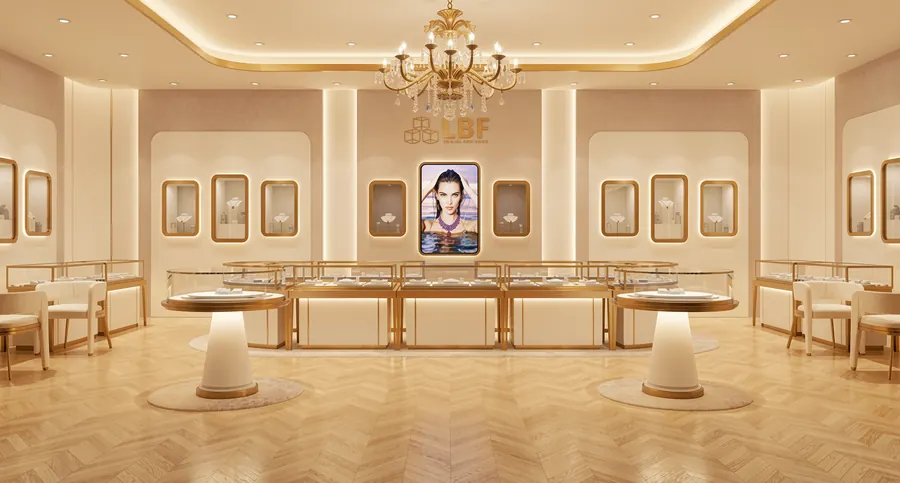
The most reliable results come from designing the case and the lighting together rather than bolting heads onto a finished cabinet. Concealed LED profiles in the frame or plinth let the light arrive at the intended angle, hide the source, and keep heat away from the object. Adjustable mounts with a 30–45° tilt range give curators and visual merchandisers room to re-aim as displays change, and low-voltage DC wiring avoids the clutter of adapters inside a sealed case. As a Guangzhou manufacturer of custom display showcases for jewelry stores, watch boutiques, museums and luxury retail, Libafang builds lighting channels, dimming and sensor integration into the case structure from the drawing stage, so lux targets are met at the object rather than estimated at the factory door.
Conservation and visual drama are not opposites. Set the lux limits by material, choose a high-CRI, low-UV source, control the beam and the on-time, and integrate the optics into the case itself. That is what separates lighting that sells from lighting that preserves — and the best display lighting does both. Tell us your artifact types and case dimensions and we will return a free lighting design and quote within two working days.